You Don’t Need Binoculars to Love This
There is a specific kind of traveler who comes to Botswana for the birds. They have a life list, a spotting scope, and a field guide with annotations in two different pen colors. They are wonderful people and they know things about the Okavango that most safari guides don’t.
Then there is everyone else – the traveler who is here for the elephants and the lions and the Delta experience, and who would describe themselves as “not really a bird person” if asked.
The carmine bee-eater migration converts the second group every year. Not into birders necessarily – though some do go home and buy a field guide – but into people who understand, for the first time, what all the fuss is about.
A cloud of carmine bee-eaters following a vehicle through the Mopane woodland is not a niche birding experience. It is one of the most visually spectacular wildlife events in southern Africa, available to anyone in Botswana between September and November, requiring no specialist knowledge and no equipment. You just have to be there.
The Carmine Bee-Eater Migration: What Actually Happens
The carmine bee eater migration is a breeding migration – the birds move from their central African range into southern Africa to breed in colonies along river banks, arriving in large numbers from late August and peaking through October.
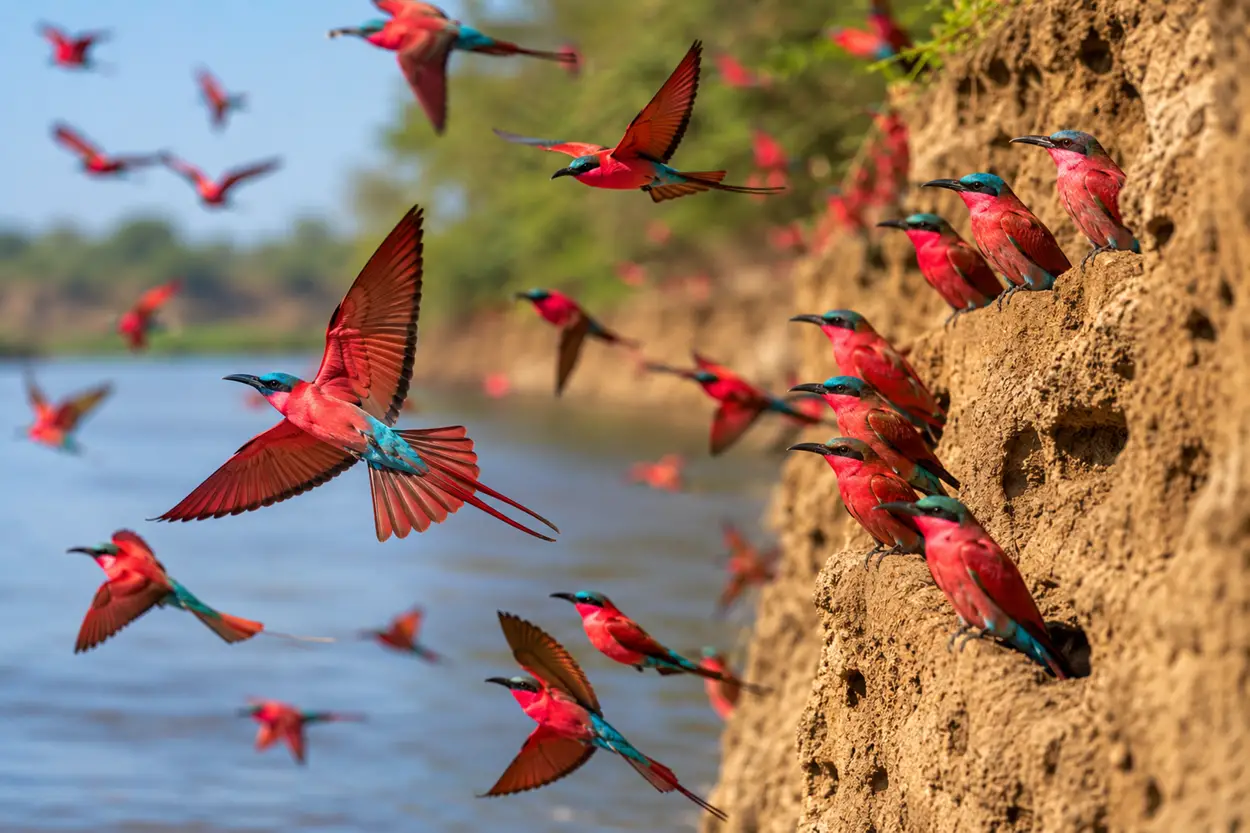
Southern carmine bee-eaters – the species present in Botswana – are among the most visually striking birds in Africa. The body is carmine red, the lower back and rump are blue, the tail is elongated, and the combination of colors catches light in a way that makes a flock of them in motion look less like birds and more like something that should be in a painting.
The colonies form along cut river banks where the birds excavate nesting burrows in the vertical earth. The Chobe River banks, the Linyanti system, and sections of the Okavango Delta produce the largest concentrations – banks that turn entirely red-pink from a distance when the colony is at full size.
The behavior that makes the carmine bee-eater famous among non-birders is the following. Carmine bee-eaters are insectivores and they are opportunists. Large animals moving through the bush disturb insects from the ground vegetation. The birds have learned – over generations, across the whole southern African range – to follow the disturbance rather than hunt independently.
Elephants are the primary benefactors. A herd moving through Mopane scrub is followed by a streaming, swooping, diving cloud of carmines catching every grasshopper, cricket, and beetle that the elephants flush. From a distance, the elephant herd appears to be wearing the birds. Up close, it is organized chaos – birds landing on elephant backs, launching from their heads, diving past their legs with the indifference of an animal that has decided this large grey thing is simply a useful hunting tool.
Game drive vehicles produce the same effect. A slow-moving vehicle through Mopane in October will accumulate a following of carmine bee-eaters within minutes, the birds working the disturbed vegetation on either side of the track and occasionally perching on the roof or the bonnet between passes.
Birding Safari Botswana: Why the Country Leads in Africa
Birding safari Botswana sits at the top of the southern African birding destination list for reasons that go beyond the carmine bee-eaters.
Botswana’s bird list exceeds 600 species, reflecting the country’s position at the intersection of multiple ecosystems – the Okavango Delta’s water-based habitats, the Chobe riverine forest, the Kalahari scrubland, and the Makgadikgadi’s open salt pan environment. Each produces different bird communities and the cumulative list is extraordinary.
For non-birders, the relevant point is that Botswana’s bird life is visual in a way that many birding destinations aren’t. The size, the color, and the behavioral spectacle of the country’s signature species – carmine bee-eaters, lilac-breasted rollers, African fish eagles, saddle-billed storks, bataleur eagles, ground hornbills – make them compelling to anyone paying attention, not just to people with a field guide.
The lilac-breasted roller, for instance, is Botswana’s unofficial national bird. It perches on exposed branches throughout the bush, catches the light in every direction differently, and produces photographs that non-photographers are proud of. The fish eagle’s call is the sound most travelers associate with the African waterway – hearing it for the first time from a mokoro on the Okavango is one of those sensory memories that doesn’t fade.
Botswana’s bird life doesn’t require a birder’s eye to engage with. It requires attention – which a good guide provides regardless of whether birds are the primary reason for the trip.
Best Time for Birding Okavango: The Seasonal Calendar
Best time for birding Okavango depends on what you’re prioritizing, because the Delta produces exceptional bird experiences across the year in different forms.
November to April – the green season is when the Okavango’s bird life is at peak diversity and activity. Migratory species from Europe and central Africa arrive in large numbers, breeding plumage is at its most vivid, and the wetland birds – herons, egrets, jacanas, storks – are nesting and feeding in concentrations that the dry season doesn’t produce. This is when serious birders come. The carmine bee-eaters overlap with the start of this period.
May to August – the dry season shifts the bird activity toward permanent water. Raptors concentrate, ground birds like kori bustards and secretary birds are highly visible on the open floodplains, and the absence of leaf cover makes finding and photographing birds significantly easier. The Delta is at its highest water level in these months, making mokoro and boat activities – which produce the best waterbird encounters – optimal.
September to November – the carmine window overlaps the transition between dry and green seasons. The carmine bee-eaters are present and at peak breeding activity. Migrant species begin arriving from late October. Game viewing is still excellent as the dry season concentrations persist. This is the window we recommend for travelers who want the carmine bee-eater experience as part of a broader Botswana trip.
Photography Safari Birds: Getting the Carmine Shot
Photography safari birds represents a different technical challenge from mammal photography, and carmine bee-eaters specifically require settings adjustments that mammal photographers don’t always have ready.
The challenge: carmine bee-eaters move fast, they are often backlit against open sky, and the crimson color is prone to blowing out in direct sunlight. A camera setting dialed in for a stationary elephant in golden hour light will produce blurred, overexposed bee-eater images.
The settings: increase shutter speed to a minimum of 1/2000 for birds in flight – 1/3200 for the fastest passes. Use continuous autofocus with bird-tracking enabled if your camera has it. Expose slightly to the right of what the meter suggests to retain detail in the red feathers without blowing to white. Shoot against the vegetation rather than the sky when possible – a bird against a green background is a better photograph than a silhouette against blue.
The opportunity: the vehicle-following behavior of carmine bee-eaters during October is one of the most accessible bird photography opportunities in Africa. The birds come to you, repeatedly, over an extended period. You don’t need to be a birder or a skilled wildlife tracker to be in the right position. You need to be in Botswana in October with the camera ready.
The colony sites along the Chobe River bank are the best stationary shooting opportunity – thousands of birds coming and going from burrows in a vertical earth bank, with morning light hitting the bank at the ideal angle from roughly 7am to 9am.
Conclusion Carmine Bees
The carmine bee-eater migration is the experience that makes non-birders understand birders. A cloud of crimson birds working an elephant herd through the Mopane, or streaming past a stationary vehicle in the golden light of a Chobe morning, is the kind of wildlife spectacle that needs no context, no field guide, and no prior interest to produce exactly the response it’s supposed to produce.
The carmine bee-eater peak runs September through October – plan the Botswana trip around this window if the timing allows
Vehicle-following behavior means the birds come to you – no specialist tracking required
Chobe River bank colonies are the best stationary photography opportunity; the Okavango Delta delivers the following behavior
Botswana’s full bird list exceeds 600 species – the carmine bee-eaters are the headline act in a very strong supporting cast
If you want a Botswana itinerary timed to the carmine bee-eater migration – with the right camps in the Chobe and the Delta, the October window locked in, and the game viewing at its seasonal peak alongside the birds – we’ve built this timing many times.
Get in touch and let’s plan it.
FAQ
When do carmine bee-eaters arrive in Botswana?
Southern carmine bee-eaters arrive in Botswana from late August, with numbers peaking through September and October and tapering into November. The peak breeding colony activity – when the river bank sites are most densely occupied and the vehicle-following behavior is most pronounced – runs through October.
Where is the best place to see carmine bee-eaters in Botswana?
The Chobe River bank between Kasane and the Linyanti system produces the largest accessible colonies. The Okavango Delta also holds carmine bee-eaters in significant numbers during the migration window, with the birds following game drive vehicles through Mopane woodland throughout the northern Delta camps. Savuti in Chobe National Park is another strong location.
Do I need to be interested in birds to enjoy a birding safari in Botswana?
No, and the carmine bee-eater migration is the clearest example of why not. The visual spectacle of a crimson flock following an elephant herd is not a birding experience in the specialist sense – it is a wildlife spectacle that happens to involve birds. Botswana’s signature bird species are large, colorful, and behaviorally compelling enough to engage any traveler paying attention.
Can I combine the carmine bee-eater migration with good game viewing?
Yes – September to November is one of Botswana’s best game viewing periods. Dry season animal concentrations around permanent water sources persist into October, and the elephant and buffalo herds that the carmine bee-eaters follow are at their most visible in the thinning dry season vegetation. The carmine window and the best game viewing window overlap almost perfectly.