The Most Famous Wildlife Photograph in Africa
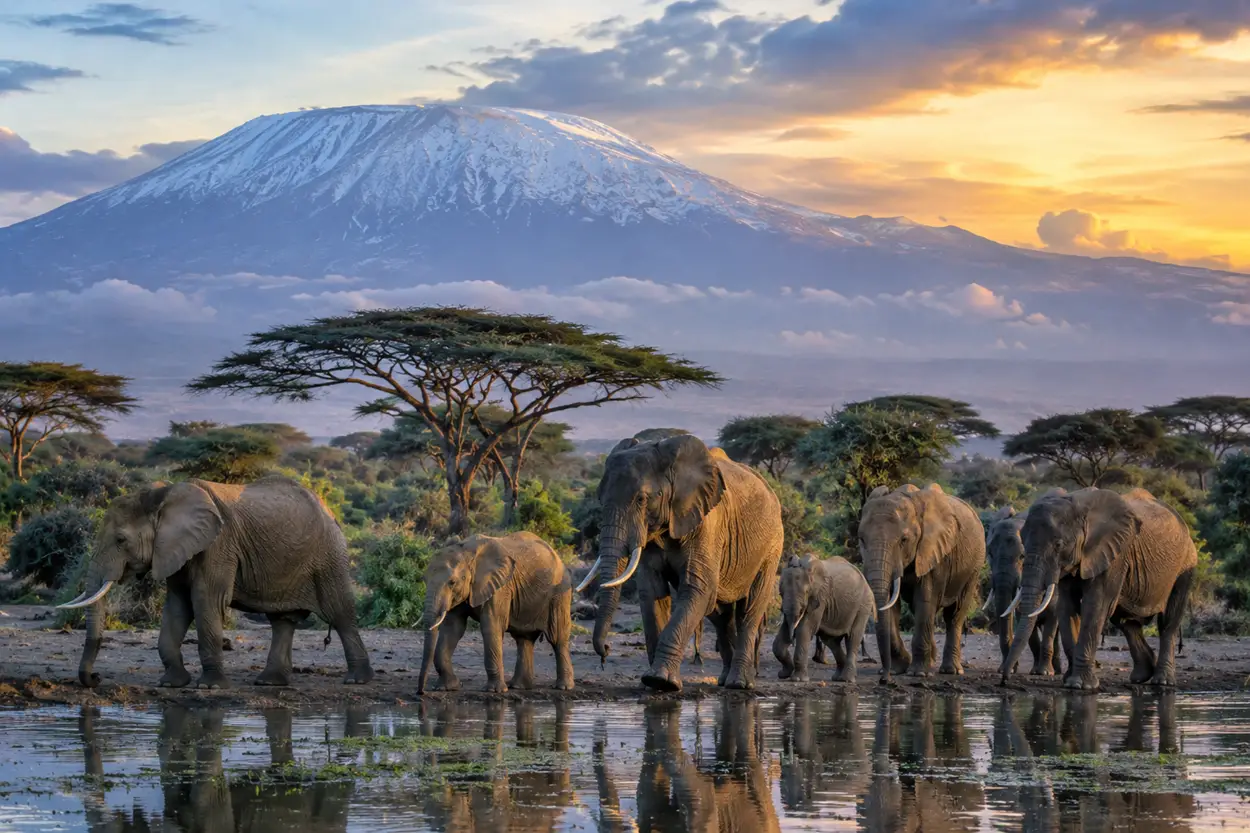
You’ve seen the image. Elephants in silhouette, dust rising from the cracked earth, and behind them – Kilimanjaro. Snow on the summit, clouds at the base, the whole mountain filling the frame.
That photograph was taken in Amboseli. It has been taken there thousands of times, by professionals and amateurs, on overcast mornings and perfect ones. It keeps working because the scene it captures is real – not staged, not lucky, but a function of what Amboseli is and where it sits.
The park lies at the foot of Kilimanjaro in southern Kenya, right on the Tanzanian border. At 5,895 meters, Kilimanjaro is the highest freestanding mountain on earth, and from Amboseli’s flat lake bed you see all of it – base to summit – with nothing in the way. Add elephants in the foreground, which Amboseli delivers in abundance, and you have the image.
Getting it requires patience, the right light, and a guide who knows where the herds are moving. We’ve helped clients plan this shot specifically, and it almost always comes together.
Amboseli National Park Safari: What Makes This Park Different
An Amboseli National Park safari is not the same as a broader Kenya safari, and Amboseli doesn’t compete with Laikipia on leopard sightings. What Amboseli does better than almost anywhere in Africa is elephants – specifically, large-tusked bull elephants with tusk genetics that no longer exist in most parts of the continent.
The park covers around 392 square kilometers, which is small by East African standards. The core ecosystem is built around a seasonal lake – Lake Amboseli – fed by underground springs from Kilimanjaro’s snowmelt. The swamps and grasslands around the lake support year-round water, which is what holds the elephants here even in dry season.
Game variety beyond elephants includes lion, cheetah, buffalo, wildebeest, zebra, and one of Kenya’s best concentrations of wetland birds. But anyone who comes to Amboseli primarily for predators is using the wrong park. This is elephant country, and it makes no apology for that.
The Elephants of Amboseli: Why the Tusks Are Bigger Here
The elephants of Amboseli carry something that is increasingly rare across Africa: genetics that produce long, heavy tusks.
During the ivory poaching crisis of the 1970s and 80s, elephants with large tusks were systematically hunted. In most elephant populations across Africa, this created a generational shift – animals with smaller tusks survived and reproduced, while the big-tusked lineages were largely eliminated. The average tusk size across African elephant populations dropped measurably over those decades.
Amboseli was relatively protected during the worst of the poaching years, and the Amboseli Elephant Research Project – the longest-running elephant research program in the world, started by Cynthia Moss in 1972 – tracked and documented the herds through that period. The result is a population that still carries the older tusk genetics. Bulls here grow tusks that reach the ground. It’s not common anymore, and Amboseli is one of the few places left where you see it consistently.
When a 50-year-old bull with meter-long tusks walks past your vehicle in the early morning light with Kilimanjaro behind him, the camera almost doesn’t matter. You just watch.
Best View of Kilimanjaro: Timing and Conditions
The best view of Kilimanjaro from Amboseli is not guaranteed – and understanding why helps you plan around it.
Kilimanjaro generates its own weather. The mountain creates cloud cover, particularly in the afternoon, and on many days the summit is obscured by mid-morning. The clearest views come in the early morning, when overnight cooling has dispersed the cloud layer and the air is cleanest. This is also when the elephants are most active – moving between the swamps and the open grassland.
The best months for clear Kilimanjaro views are January-February and June-October. The long rains (April-May) cloud the mountain consistently and are the least reliable period for the classic shot. December and March offer mixed results depending on the year.
The practical implication: your first game drive of the day matters more in Amboseli than in almost any other park. Get out at dawn, position near the lake bed, and give the morning time to develop. The mountain either appears or it doesn’t, but the elephants will be there regardless.
Tortilis Camp Review: The Right Base for Amboseli
Tortilis Camp sits just outside the national park boundary on a private conservancy, with direct views toward Kilimanjaro and unfenced access to the surrounding ecosystem.
The camp is named after the acacia tortilis trees that define the landscape – flat-topped, widely spaced, with the mountain visible through the canopy from almost every point on the property. The design is classic East African tented camp: spacious canvas suites, open-air dining, a pool positioned for the Kilimanjaro view.
What makes Tortilis work as a base for Amboseli specifically:
Location – positioned on the park’s northwestern edge, close to the lake bed where the iconic photographs are taken
Private conservancy access – game drives on the conservancy land mean you’re not restricted to park hours, which matters for early morning and late afternoon light
Guide quality – Tortilis guides know where the big bulls are. Amboseli’s elephant population has been studied for over 50 years and many individuals are known by name. A good guide turns a game drive here into something closer to a wildlife biography lesson.
For families, Tortilis handles children well and the flat, open terrain of Amboseli makes it one of the easier parks for younger travelers to engage with – sightlines are long, animals are visible from a distance, and there’s never a sense of searching for something that isn’t there. It also pairs cleanly with the Kenya conservancy experience for travelers who want a more complete safari circuit.
Conclusion
Amboseli is the park that delivers the image Africa is known for – not as a lucky shot, but as a repeatable, plannable experience for travelers who show up at dawn and give the morning time to unfold. Its elephants still carry tusk genetics largely lost in the rest of Africa, the clearest Kilimanjaro views usually come in the first two hours after sunrise, and Tortilis Camp combines the right location with conservancy access and guide knowledge that actually matters. January-February and June-October are the most reliable months for both mountain views and game, which makes timing the difference between hoping for the shot and properly planning for it.
If you want a Kenya itinerary with Amboseli positioned correctly – the right camp, the right number of nights, and a guide who knows the big bulls by name – we’ve built this circuit many times and we know how to make the morning count.
Get in touch and let’s plan it.
FAQ
What is the best time to visit Amboseli National Park?
January-February and June-October give the best combination of clear Kilimanjaro views and good game conditions. The dry season (June-October) concentrates animals around the swamps and produces the most reliable elephant sightings. January-February offers clear skies after the short rains and is often less crowded than the main July-August peak.
Why are the elephants of Amboseli different from other parks?
Amboseli’s elephant population retained its large-tusk genetics through the poaching years of the 1970s-80s when most African populations lost theirs. The Amboseli Elephant Research Project has tracked individual animals since 1972, making this one of the most studied elephant populations on earth. The result is bulls with tusks that reach the ground – a sight that has largely disappeared from the rest of Africa.
Is Tortilis Camp worth it for an Amboseli safari?
Yes. The combination of location, conservancy access, and guide knowledge makes it the camp we recommend most consistently for Amboseli. It’s not the only good option in the ecosystem, but it sits in the right spot, runs good operations, and the views from camp are as good as the views on the drive.
How do I get the Kilimanjaro elephant shot?
Position near the dry lake bed on the first drive of the day, ideally between 6:30 and 8:30am when the light is low and the cloud cover on the mountain is at its thinnest. A wide-angle lens captures the scale better than a telephoto. Ask your guide the night before to plan the morning around the lake bed approach – they know the elephant movements and can put you in the right place.