What Are Desert Adapted Elephants?
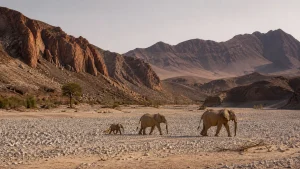
Desert adapted elephants are not a separate species – they’re African bush elephants (Loxodonta africana) that have developed behavioral and physiological adaptations to survive in arid environments with minimal water and sparse vegetation. The population in Namibia’s Kunene Region, centered around Damaraland and the Skeleton Coast hinterland, is one of only two desert elephant populations in the world. The other is in Mali.
What makes them visually distinct from other elephant populations:
Longer legs relative to body size – an adaptation for covering vast distances between water sources
Larger feet – wider, flatter soles that distribute weight better on soft sand and rocky desert terrain
Leaner body condition – less fat stored than elephants in wetter ecosystems, reflecting the caloric demands of desert survival
Smaller overall body size – generations of resource scarcity have produced slightly smaller animals than savannah populations
These are elephants shaped by landscape. The Damaraland environment is written into their bodies.
Where to See Desert Elephants in Namibia
The desert adapted elephants of Namibia move through a vast territory covering the dry riverbeds and rocky plains of the Kunene Region – an area of roughly 25,000 square kilometers with almost no permanent water.
The key locations for sightings:
| Area | Notes |
|---|---|
| Huab River Valley | Most reliable sighting area – elephants use the dry riverbed as a highway |
| Uniab River | Less visited, more remote, excellent for tracking on foot |
| Hoanib River | Further north, larger elephant groups, connects to Skeleton Coast |
| Palmwag Concession | Private concession with guided tracking experiences |
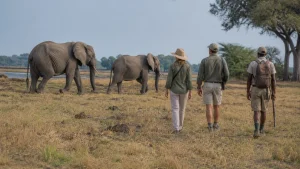
The Huab River Valley near Twyfelfontein is where to see desert elephants most reliably. The dry riverbed acts as a natural corridor – elephants walk it daily between grazing areas and the subsurface water they dig for with their trunks and feet. Tracking them here means following footprints in the sand, reading the landscape for broken branches and fresh dung, and arriving at a sighting that feels earned rather than delivered.
Damaraland Safari Guide: The Landscape Behind the Elephants
Damaraland is one of the most visually arresting regions in Africa. The Damaraland safari experience is built on a landscape of ancient volcanic rock formations, rust-red plains, dry riverbeds lined with ana trees, and a silence so complete it has a physical texture.
Key sites within the region:
Twyfelfontein – a UNESCO World Heritage Site containing over 2,000 rock engravings made by San hunter-gatherers over thousands of years. The engravings depict elephants, rhinos, lions, and giraffe on the same rock faces where those animals still live today.
Brandberg Mountain – Namibia’s highest peak at 2,573 meters, rising dramatically from the desert floor. The Tsisab Gorge contains the famous White Lady rock painting, one of southern Africa’s most significant prehistoric artworks.
Burnt Mountain and Organ Pipes – a geological formation of dark, weathered dolerite columns rising from the desert floor in near-perfect parallel rows. It looks constructed. It isn’t.
Petrified Forest – ancient tree trunks turned to stone over 260 million years, lying scattered across the open desert. The scale of geological time in Damaraland is impossible to ignore.
The elephants move through all of this. A tracking day in Damaraland is simultaneously a wildlife experience and a geology lesson and an encounter with human history going back thousands of years.
Namibia Wildlife Adaptation: How Desert Elephants Survive
The survival strategies of Damaraland’s elephants represent some of the most sophisticated Namibia wildlife adaptation documented in large mammals.
Water finding – desert elephants can smell water underground at depths of up to a meter. They dig with their feet and trunks to access subsurface moisture in dry riverbeds, creating water holes that other species – zebra, giraffe, gemsbok, black rhino – subsequently use. They are, functionally, water engineers for their entire ecosystem.
Distance covered – GPS tracking studies have recorded Damaraland elephants walking up to 70 kilometers per day in search of food and water during dry periods. Savannah elephants typically cover 10 to 20 kilometers. The energetic cost of this is reflected in their leaner condition.
Feeding flexibility – desert elephants eat plants that savannah elephants avoid entirely: bitter desert melons for moisture, dry bark for fiber, toxic plants in small quantities. Their gut flora has adapted to process vegetation that would cause digestive problems in other populations.
Social knowledge – desert elephant herds are led by older matriarchs who carry mental maps of water sources, seasonal grazing areas, and migration routes accumulated over decades. Remove the matriarch and the herd’s survival capacity drops dramatically. This is why poaching of older females has such disproportionate long-term consequences for desert populations.
Camping in the Dry Riverbeds
The most immersive way to experience Damaraland is to sleep in it – specifically in the dry riverbeds where the elephants walk.
Several operators run mobile camping experiences that set up fly camps in the Huab or Hoanib riverbeds, moving with the elephants’ seasonal patterns. You go to sleep with the sound of nothing, wake before dawn, and sometimes find elephant tracks that passed within meters of your tent during the night.
This is not luxury camping in the conventional sense. There are no permanent structures, no floodlit waterholes, no camp bar. What there is: a cot under the stars in one of the emptiest landscapes on earth, with the knowledge that the animals you came to find were here while you slept.
For travelers who want comfort alongside the experience, Mowani Mountain Camp and Grootberg Lodge provide the best fixed-base options in the region.
Mowani Mountain Camp and Grootberg Lodge
Mowani Mountain Camp sits on a rocky granite outcrop above the Huab River Valley with views over the desert plains in every direction. The 12 tented rooms are built around the boulders rather than on top of them – the camp feels like it grew out of the landscape rather than being placed on it. Tracking excursions into the Huab Valley for desert elephants run daily, and the camp’s guides have decades of experience reading the riverbed.
Grootberg Lodge is a community-owned property on the edge of the Palmwag Concession, run in partnership with the local Damara community. The location on a cliff edge gives extraordinary sunrise views, and the lodge’s connection to community conservancy land means game drives access areas that standard tourism routes don’t cover. Grootberg is also one of the best bases for black rhino tracking in the region – Damaraland holds one of Africa’s highest densities of free-ranging black rhino.
Conclusion Damaraland Elephants
Damaraland’s elephants are the product of an extreme environment that has shaped them over generations into something genuinely distinct. Tracking them through a dry riverbed in a landscape that looks like the beginning of the world is one of those experiences that resets your sense of what a safari can be.
Desert adapted elephants are physically and behaviorally distinct from savannah populations
The Huab and Hoanib riverbeds are the key tracking areas
Mowani Mountain Camp and Grootberg Lodge are the best fixed bases in the region
Damaraland pairs naturally with Etosha for a complete Namibia itinerary
If Damaraland is on your Namibia radar and you want the elephant tracking built into an itinerary that makes the most of the region – right camp, right guide, right combination with Etosha or the Skeleton Coast – we’ve traveled these riverbeds ourselves and we know how to put it together.
Get in touch and let’s plan it.
FAQ
Where to see desert elephants in Namibia?
The Huab River Valley near Twyfelfontein is the most reliable location, with the Hoanib River further north offering larger groups and more remote sightings. Both areas are accessed through guided experiences from camps in the Damaraland and Kunene regions – self-drive tracking is not recommended as the elephants cover vast distances and the terrain is demanding.
What is the best time to visit Damaraland for elephant tracking?
Year-round, but the dry season from May to October concentrates elephants more predictably along the main riverbeds as surface water disappears. The green season brings better vegetation and occasional rain, which disperses the herds more widely but produces dramatic desert landscapes after rainfall.
Are Damaraland’s desert elephants dangerous?
They are wilder and less habituated to vehicles than elephants in heavily visited parks, and require more careful approach. Experienced guides manage distances and approach angles accordingly. The tracking experience is safe when conducted properly – the key is using operators whose guides have specific desert elephant experience rather than conventional safari guiding backgrounds.
Can I combine Damaraland with Etosha on the same Namibia itinerary?
Absolutely – it’s one of Namibia’s best combinations. Three nights in Damaraland for the elephants, rock art, and geology, followed by three nights in Etosha for the waterhole game viewing, covers the full range of what Namibia offers as a safari destination.