TL;DR – Kaokoland is the remote northwestern corner of Namibia where the GPS stops being reliable, the tracks disappear into riverbeds, and desert-adapted elephants walk routes that haven’t changed in centuries. It is one of the last genuinely wild places in southern Africa – and Hoanib Valley Camp is the base that makes it accessible without making it easy.
- Kaokoland requires a fly-in for most travelers – the access roads demand expedition-level preparation
- The desert-adapted elephants of the Hoanib River are behaviorally and physiologically distinct from bush elephants – the guides know them individually
- Hoanib Valley Camp provides genuine wilderness access with none of the expedition logistics
- Kaokoland works best at the end of a Namibia circuit after Etosha and the Skeleton Coast – the progression from accessible to remote earns the destination
A Place Where GPS Doesn’t Work
There are remote places in Africa and then there is Kaokoland.
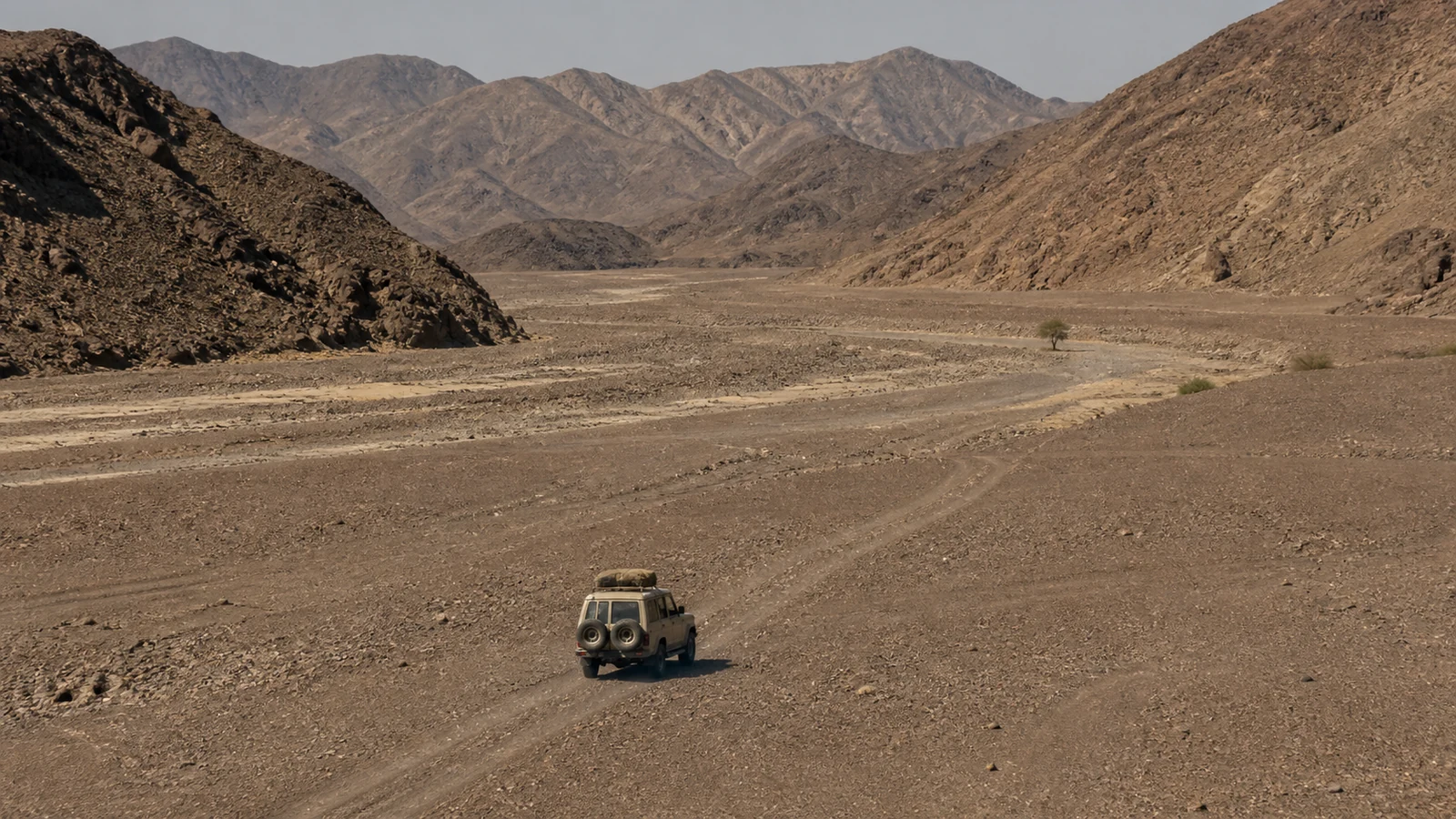
The Kaokoland region occupies Namibia‘s far northwest – a landscape of mountain desert, dry riverbeds, and vast gravel plains that receive between 25 and 150 millimeters of rain per year, most of it unpredictably. The nearest town of any size is Opuwo, which is itself a four-hour drive from Palmwag and a full day’s drive from Windhoek. Beyond Opuwo, the roads deteriorate into tracks, the tracks deteriorate into riverbeds, and the riverbeds require an experienced driver with recovery equipment and a genuine understanding of desert navigation.
A Kaokoland safari is not a drive with occasional rough sections. It is an expedition in the technical sense – a journey into a landscape that does not accommodate the unprepared and does not forgive the overconfident. The GPS coverage is patchy because the detailed mapping simply doesn’t exist for much of the region. The tracks change after rain. The distances between anything are enormous.
For the traveler who finds this description appealing rather than alarming, Kaokoland delivers what almost nowhere else in Africa can: the feeling of being genuinely far from the world that made you.
Remote Namibia: The Kaokoland Landscape
Remote Namibia at its most extreme is Kaokoland. The region covers approximately 49,000 square kilometers with a human population of around 30,000 people – almost entirely Himba pastoralists who have lived in this landscape for centuries.
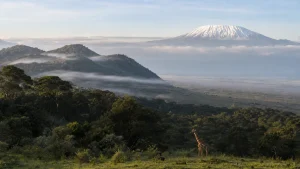
The topography is dramatic and varied in a way that photographs struggle to communicate. The Hartmann Valley drops steeply toward the Kunene River on the Angolan border – a canyon system visible from the ridgelines above that looks designed rather than geological. The Marienfluss Valley, accessible via the Van Zyl’s Pass – one of the most technical 4WD passes in southern Africa – opens into a flat plain surrounded by mountains where the light at dawn turns the sandstone red in a way that stops most people mid-sentence.
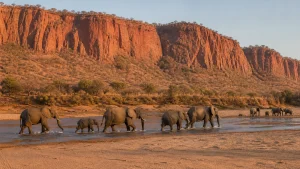
The Hoanib River runs through the center of the region as a dry riverbed for most of the year, flooding briefly after significant rains and leaving behind a ribbon of vegetation that supports life in quantities the surrounding desert cannot. The Hoanib is the highway of Kaokoland – the route that the desert elephants follow, the lions patrol, and the oryx and springbok concentrate along in the dry months.
Wildlife in Kaokoland is sparse by East African standards and extraordinary by any other measure. The desert-adapted populations of elephant, lion, black rhino, and giraffe here have evolved behavioral and physiological traits – covering enormous distances between water, metabolizing moisture from food, moving at night to avoid heat – that their savanna counterparts don’t need. Seeing a desert elephant is not the same as seeing an Amboseli elephant. The animal looks the same and is a fundamentally different creature.
Off Road Expedition Namibia: What Getting There Involves
An off road expedition Namibia itinerary into Kaokoland requires planning that goes beyond normal safari logistics.
The vehicle requirement – a standard 4WD is not sufficient for deep Kaokoland. The Van Zyl’s Pass and the Hartmann Valley require high-clearance, short-wheelbase 4WDs with low-range gearing, recovery equipment, and spare fuel capacity. Most rental companies explicitly exclude their vehicles from Kaokoland tracks. The serious expedition options are either a guided vehicle with an experienced Kaokoland driver or a fly-in to Hoanib Valley Camp that bypasses the access roads entirely.
The self-drive reality – independent travel in Kaokoland is possible for experienced off-road drivers with proper preparation, but it is genuinely not recommended for first-time visitors. The distances between assistance are large enough that a single vehicle failure, a vehicle stuck in a riverbed, or a navigation error creates a situation that takes days rather than hours to resolve. Two-vehicle minimum is the standard recommendation for anyone driving independently.
The fly-in option – Hoanib Valley Camp and the other Kaokoland properties operate their own charter flights from Windhoek and from other Namibia lodges. The flight from Windhoek to the Hoanib airstrip takes approximately two hours and deposits you directly into the landscape without the two-day overland approach. The access roads are part of the expedition experience for some travelers and a genuine deterrent for others. The fly-in serves the second group without compromising the destination.
Hoanib Valley Camp: The Base That Gets It Right
Hoanib Valley Camp sits in the dry Hoanib River valley in the heart of Kaokoland, operated by Wilderness Safaris as part of their Classic portfolio. It is the property that made this part of Namibia accessible to travelers who want the genuine wilderness experience without the full expedition logistics.
The camp has eight tents positioned along the riverbank, open-fronted to the valley view, with the Hoanib River channel visible from the sleeping area. The design is deliberately understated – canvas and natural materials that don’t interrupt the landscape they sit in. At night, with no other light source within a hundred kilometers, the camp disappears into the darkness and the sky takes over.
What Hoanib Valley Camp does that distinguishes it from a standard Namibia lodge:
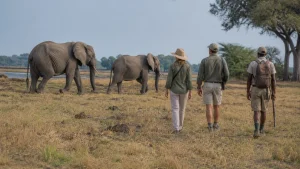
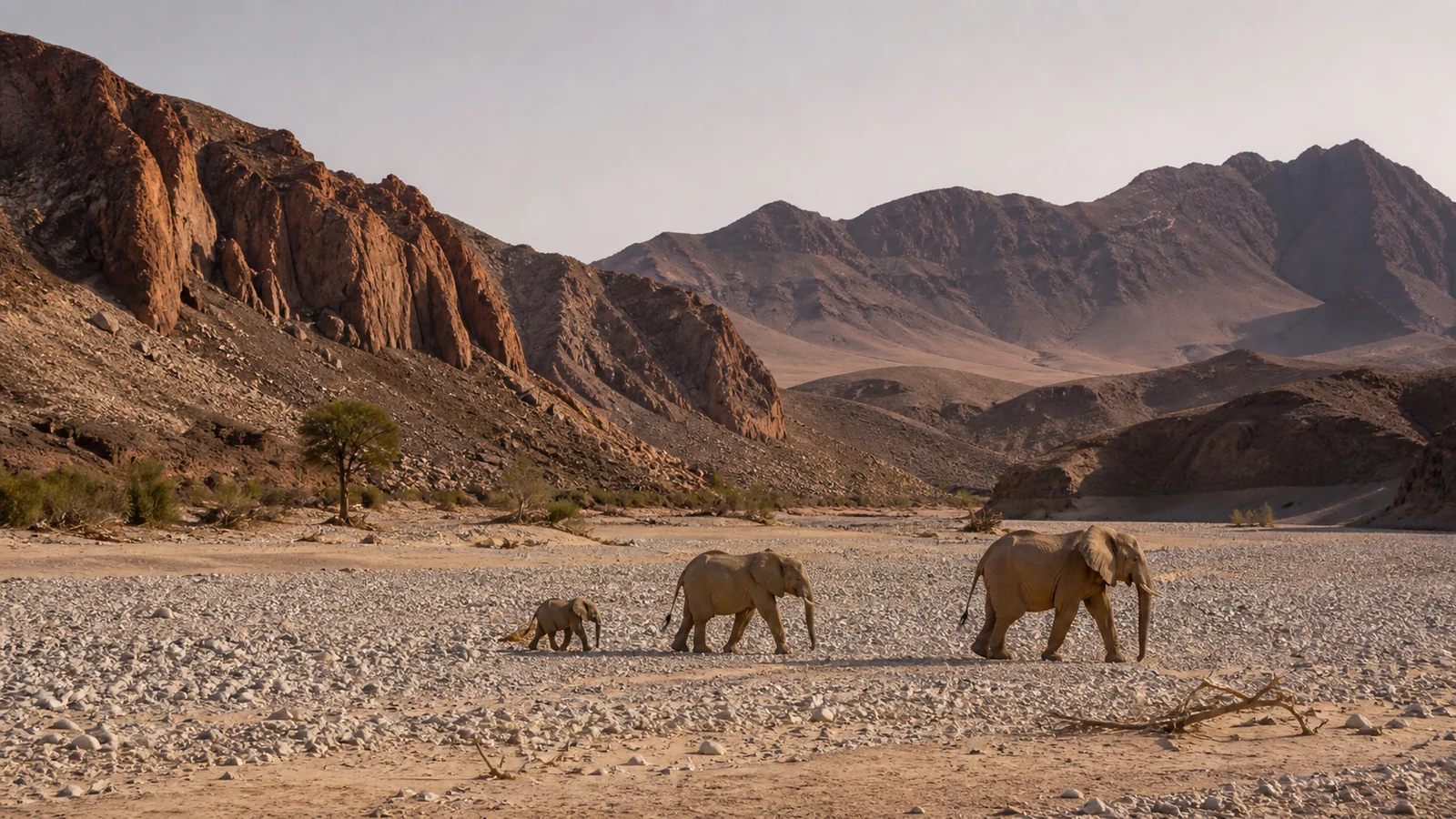
The desert elephant experience – the guides at Hoanib have tracked the Hoanib River elephants for years and know the family groups individually. The desert elephants move differently from bush elephants – longer legs, larger feet, a gait adapted for covering ground efficiently – and watching them navigate the riverbed at close range, with guides who can identify individuals and explain the behavioral differences in real time, is the defining experience of a Hoanib stay.
The predator tracking – Kaokoland’s lion population is one of the most remarkable in Africa. Desert-adapted lions range enormous territories, sometimes exceeding 2,000 square kilometers for a single pride, and their behavioral adaptations – hunting at night, using the riverbed as a navigation corridor, targeting gemsbok and giraffe that other lion populations rarely tackle – make them a subject that wildlife researchers have studied for decades. The Hoanib guides track these lions on foot and by vehicle across terrain that produces sightings with no other camp in the vicinity.
The Himba cultural visits – Kaokoland is Himba territory and the Himba communities living near the Hoanib camp maintain a traditional pastoral lifestyle that has changed less in the past century than almost any other culture in Africa. Hoanib Valley Camp facilitates respectful visits to these communities as part of the experience, with guides who speak Otjihimba and understand the protocol. The visits are not performances – they are genuinely reciprocal exchanges between guests and a community that chooses to engage on its own terms.
The Vanishing Kings: Desert-Adapted Wildlife
The phrase “desert-adapted” in Kaokoland is not a marketing qualifier. It describes real physiological and behavioral changes in wildlife populations that have lived in the Namib for generations.
The desert elephants of the Hoanib are the most documented example. They travel up to 70 kilometers per day in search of food and water – distances that would exhaust a bush elephant within days. Their feet are wider relative to body size, distributing weight across soft sand more efficiently. They dig for water in dry riverbeds, creating water sources that smaller animals exploit after the elephants move on. They have been known to go four to five days without drinking, metabolizing moisture from the vegetation they consume.
The desert lions are less studied and more enigmatic. Namibia’s desert lion population dropped to fewer than 25 individuals in the early 2000s due to conflict with farmers and trophy hunting. Conservation work over the past two decades has rebuilt the population slowly. The lions in the Hoanib area represent one of the most significant surviving populations and one of the least observed by mainstream tourism. Seeing them is not guaranteed. Being in the landscape where they exist is itself an experience.
Only One Safaris on Reaching Kaokoland Without Losing Days to the Drive
Kaokoland is the Namibia that exists after the famous landscapes run out – after Sossusvlei, after Etosha, after Swakopmund. It is the part that most itineraries don’t reach and that rewards the traveler who does with the specific silence of a landscape that has remained fundamentally unchanged since the desert elephants first walked the Hoanib riverbed.
If you want a Namibia itinerary that reaches Kaokoland properly – with the fly-in arranged, the camp secured, and the rest of the circuit building toward it – we’ve built this routing many times.
Get in touch and let’s go there.
Frequently Asked Questions: Kaokoland: The Final Frontier
What is Kaokoland in Namibia?
Kaokoland is the remote northwestern region of Namibia, covering approximately 49,000 square kilometers of mountain desert, dry riverbeds, and vast gravel plains. It is home to desert-adapted populations of elephant, lion, black rhino, and giraffe, as well as the Himba people who have inhabited the landscape for centuries. It is one of the least-visited and most genuinely wild regions in southern Africa.
How do I get to Hoanib Valley Camp?
By charter flight from Windhoek or from other Namibia lodge airstrips. The flight takes approximately two hours from Windhoek. Road access to the Hoanib Valley requires a highly capable 4WD, recovery equipment, and significant off-road experience – the fly-in option is strongly recommended for all but experienced expedition drivers.
What wildlife can I see in Kaokoland?
Desert-adapted elephant, lion, black rhino, giraffe, Hartmann’s mountain zebra, oryx, springbok, and a wide range of desert-adapted bird species. Wildlife density is lower than savanna destinations but the behavioral adaptations of the desert populations and the absence of other tourists make sightings more significant than density comparisons suggest.
Is Kaokoland suitable for first-time Africa travelers?
As a fly-in destination like Hoanib Valley Camp, yes – the expedition logistics are handled and the camp provides a comfortable, well-guided base. As a self-drive expedition, no – Kaokoland’s access roads require experience and preparation that first-time Africa visitors typically don’t have. We match the access format to the traveler’s experience level and the itinerary’s logistics.