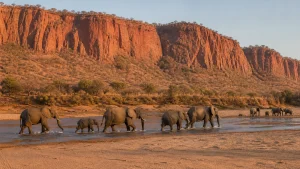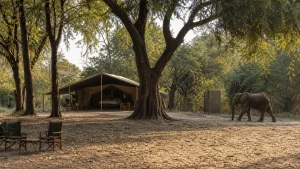
TL;DR – In the Okavango Delta, two camps offer something that almost nowhere else in Africa can: a genuine, ethical, up-close encounter with habituated elephant herds. Abu Camp and Stanley’s Camp have been doing this for decades. The experience of walking alongside an elephant – close enough to touch – is one of the most affecting things a traveler can do in Botswana.
- Abu Camp and Stanley’s offer two of the world’s most ethical habituated elephant experiences
- Neither program involves riding or performance – the elephants engage on their own terms
- Family safaris in Botswana should include this experience without exception
- Both camps book out early in peak season – lock it in as part of itinerary planning
Trunk-in-Hand With a Giant
There is a specific moment that every person who has done the elephant interaction at Abu or Stanley’s describes the same way. You’re standing in the bush, no fence between you and the animal, and an elephant turns and looks at you from a foot away. Not at you as a threat. Not at you as a curiosity. Just – at you.
The eye is amber and enormous and completely calm. And for a second, the distance between human and animal collapses in a way that no game drive, no photograph, no documentary ever quite manages.
That moment is what we’re talking about when we talk about elephant interaction Botswana. Not a ride. Not a performance. A meeting.
The Ethical Habituated Herds: How This Actually Works
The word “habituated” carries a lot of weight in conservation circles, and it should. Habituation done badly produces animals that are stressed, dependent, or dangerous. Done well, it produces something genuinely different.
Abu Camp’s elephant program began with Randall Moore in the early 1990s, starting with rescued and orphaned elephants that could not be released into the wild. Over decades, the herd has grown to include both those original animals and wild-born calves raised within the group. The elephants live wild, range freely, and are not ridden or made to perform. The interaction is structured around walking with them in their environment – on their terms, at their pace.
Stanley’s Camp runs a similar program under the “Living with Elephants” banner, founded by Doug and Sandi Groves who have dedicated decades to elephant research and welfare. The herd at Stanley’s has a different character – older bulls, a different social structure – and the experience reflects that.
What makes both programs defensible as ethical animal encounters is the absence of coercion. These elephants are not trained to accept people. They are comfortable with people because they grew up in an environment where people were present and trustworthy. The distinction matters, and both camps are transparent about it.
Abu Camp Elephant Experience: What a Morning Looks Like
The Abu Camp elephant experience runs as a morning walk, typically starting just after sunrise when the bush is cool and the elephants are moving.
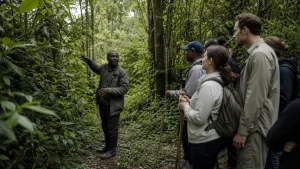
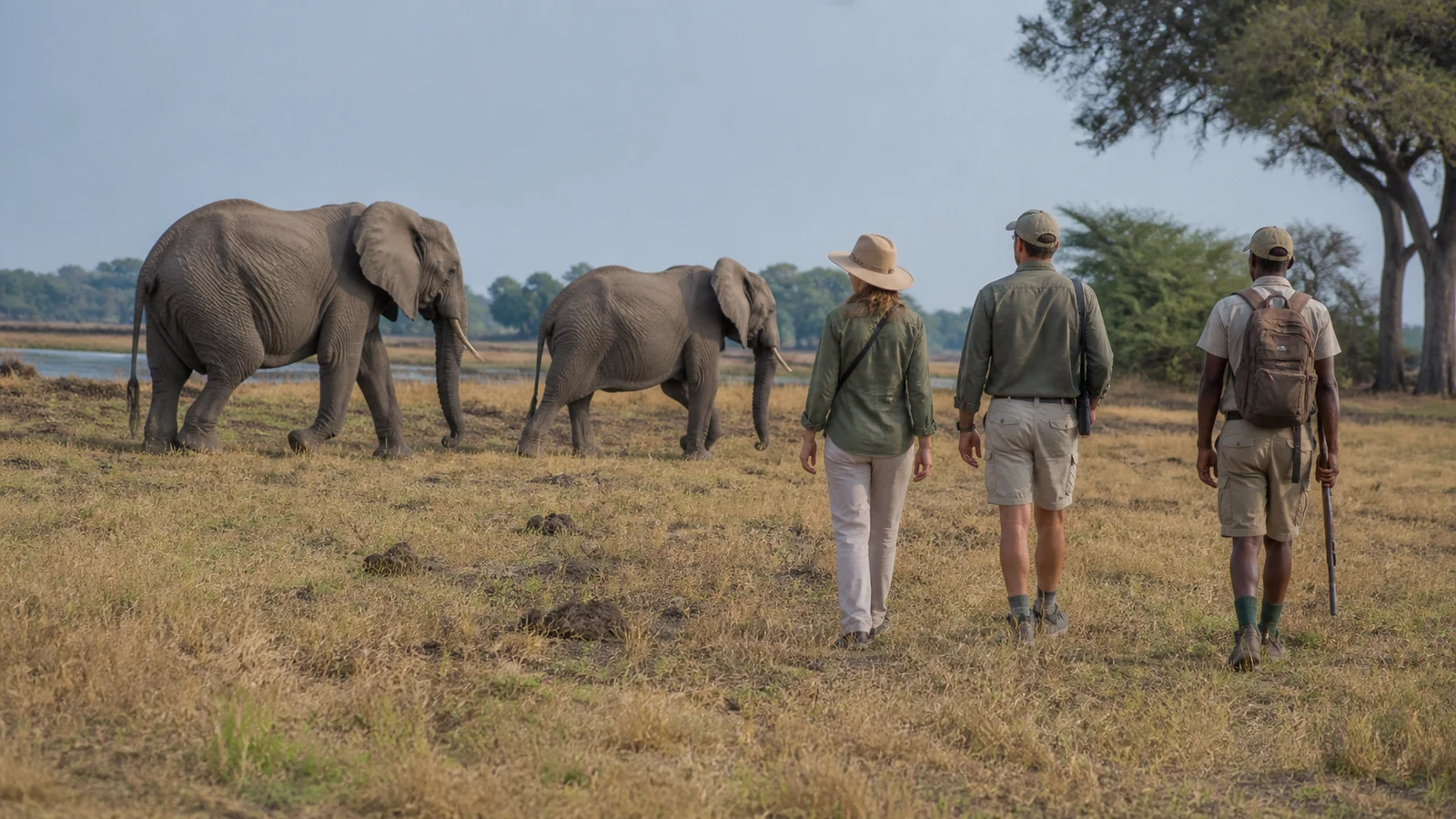
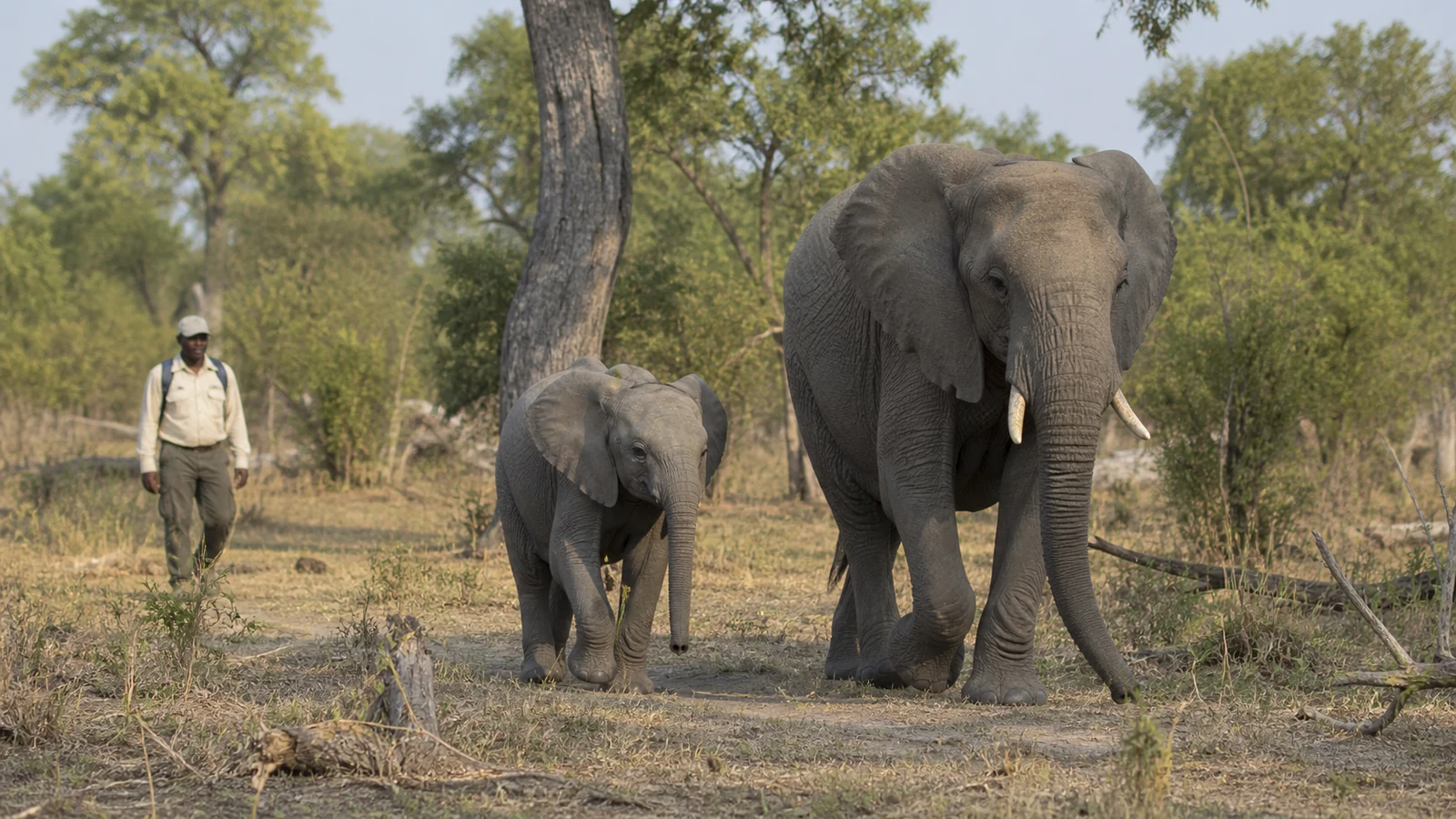
You meet the herd on foot with a trained elephant guide – usually one of the handlers who has worked with these specific animals for years. The guide reads the herd’s mood, positions the group, and mediates the interaction. You don’t approach the elephants. You walk alongside them and let them decide how close they want to be.
What happens in practice: the elephants move through the bush at their own pace, feeding, rumbling to each other, occasionally turning toward the group with what can only be described as curiosity. Calves, in particular, are bold – they’ll walk straight up to a guest while their mothers watch with apparent indifference.
The walk lasts one to two hours. Afterward, Abu Camp typically includes a bush breakfast in the field with the herd nearby. It is, by any measure, one of the most unusual meals available in Africa.
Stanley’s Camp Living With Elephants: A Different Energy
The Stanley’s Camp Living with Elephants program carries a research dimension that Abu’s doesn’t. Doug and Sandi Groves have been studying the elephants of the Okavango for decades, and time with their herd feels less like an activity and more like a field session with two people who know these animals as individuals.
Stanley’s tends to attract guests who want depth alongside the experience – people who want to understand elephant cognition, social structure, and communication, not just stand near a large animal. The program includes extended time in the field with commentary that goes well beyond what a standard game guide covers.
For guests who’ve done Abu and want a different angle on the same fundamental experience, Stanley’s is the natural next stop. For first-timers choosing between the two, Abu’s polish and infrastructure make it the slightly easier entry point. Stanley’s rewards curiosity.
Why This Is Life-Changing for Kids
We’ve sent a lot of families through both programs, and the pattern is consistent: the adults think it will be the highlight and it is. The kids think it will be cool and it rewires them.
There’s something about the scale of an elephant – seen from ground level, at arm’s length, with no glass or vehicle between you – that hits children differently than adults. Adults process it intellectually. Kids just absorb it. We’ve had parents report that their 10-year-old came home and announced they wanted to study zoology. We’ve had teenagers who barely looked up from their phones during the flight turn completely silent the moment the herd arrived.
For family safaris in Botswana, the elephant interaction is one of the few experiences we will actively push for regardless of what else is on the itinerary. Game drives are spectacular. This is personal.
How Only One Safaris Places the Elephant Experience in a Botswana Itinerary
The Okavango Delta has extraordinary wildlife. The elephant interaction at Abu and Stanley’s is something different – it’s the moment a traveler stops watching wildlife and starts being present with it. Kids feel it immediately. Adults take a day to stop processing and just let it land.
If you want a Botswana itinerary with the elephant interaction built in properly – the right camp matched to the right traveler, alongside the Delta game drives and the rest of the circuit – we’ve done this combination many times.
Get in touch and let’s put it together.
Frequently Asked Questions: Elephant Interaction: Meeting the Herd
What is the difference between Abu Camp and Stanley’s Camp elephant experience?
Abu Camp offers a polished, well-structured interaction with a large habituated herd in the Okavango Delta – ideal for first-timers and families. Stanley’s Camp Living with Elephants has a stronger research and education dimension, led by Doug and Sandi Groves who have studied these specific animals for decades. Both are ethical, both are exceptional, and the choice comes down to whether you want a guided encounter or a field study.
Are elephant interactions in Botswana ethical?
The programs at Abu and Stanley’s are among the most defensible elephant interaction experiences in the world. Neither camp involves riding, performing, or coercing the animals. The herds are habituated over decades through respectful, consistent presence – not training. Both operators are transparent about their methods and conservation philosophy.
Is the elephant interaction suitable for children?
Yes, and in our experience it’s often the most powerful experience of a family safari. There’s no minimum age, but children should be old enough to follow guide instructions and remain calm around the animals. We typically recommend it for children eight and above, though younger kids have done it successfully with attentive parents.
How do I book the Abu Camp or Stanley’s Camp elephant experience?
Both experiences are primarily available to in-house guests, which means booking the camp is the first step. The interaction is then arranged as part of the daily activity schedule. We handle the full coordination as part of itinerary planning – both camps have limited capacity and book out well in advance during peak season.