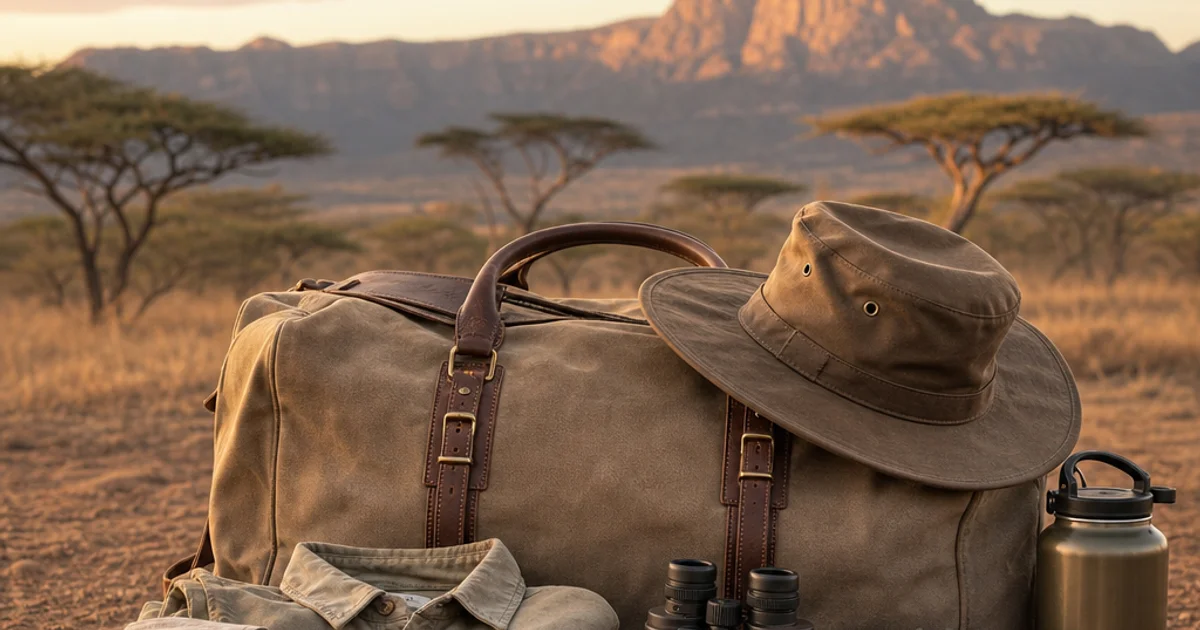
There is a moment — it happens to almost everyone on their first African safari — when the vehicle stops, the engine cuts, and the silence hits you like something physical. You are in it. The dust, the light, the animals, the vastness. Nothing you packed prepared you for the feeling. But what you packed absolutely determines how comfortable, how confident, and how fully present you are when that moment arrives.
This guide does not treat Africa as a single climate or a single experience. A dawn game drive in the Serengeti in July is a different world from an afternoon walk in Zambia’s South Luangwa, which is nothing like pulling on gaiters before a gorilla trek in Uganda’s Bwindi Impenetrable Forest. Your kit needs to reflect that reality — practical, adaptable, and built for the adventure you are actually going on.
- Internal bush flights enforce strict weight limits — typically 15–20 kg total — and require soft-sided bags only. Hard-shell suitcases are not permitted.
- Neutral earthy tones are non-negotiable for your safari wardrobe. Bright colors and dark blue or black clothing cause real problems in the field.
- Africa compresses an entire day of temperatures into 12 hours — layering is not optional, it is the system that makes every game drive comfortable.
- Different activities demand different footwear: gorilla trekking in Uganda or Rwanda requires proper waterproof hiking boots; game drives need nothing more than closed-toe comfort shoes.
- Most lodges offer laundry services — you do not need a fresh outfit for every single day. Pack smart, pack light, and enjoy the freedom that comes with it.
Before You Pack a Thing: Understanding Safari Luggage Rules
Most internal safari flights enforce a strict 15–20 kg soft-sided luggage limit — hard-shell suitcases are typically not permitted on bush aircraft. If this is news to you, you are not alone. It is the single most common shock for first-time safari travelers, and it changes everything about how you approach packing.
Picture a small propeller aircraft — a Cessna Caravan, perhaps — sitting on a dirt airstrip somewhere between the Masai Mara and the Serengeti. The cargo hold is a narrow, awkwardly shaped compartment tucked behind the passenger cabin. Bags are fitted in like puzzle pieces. A rigid suitcase with wheels simply does not fit. It is not a preference. It is physics.
The Non-Negotiable Rules of Safari Luggage
- Bag type: Soft-sided duffel bags only. No hard shells, no rigid frames, no wheeled suitcases (unless your specific operator explicitly permits them at a particular destination).
- Weight limit: 15 kg to 20 kg per person total, including hand luggage. Check with your operator — limits vary by airline, region, and aircraft type.
- Dimensions: Many bush airlines specify maximum bag dimensions — typically around 25 cm x 30 cm x 62 cm. Confirm before departure.
- Multi-country itineraries: If your safari spans Kenya and Tanzania, or Botswana and Zimbabwe, always assume the strictest weight limit applies throughout and pack accordingly from day one.
The Gear That Helps You Manage It
A quality set of packing cubes is not a luxury on a safari — it is a sanity-saving tool when you are living out of a duffel bag for 10 days or more. Cubes let you find your fleece at 5:00am without unpacking everything in the dark. They compress clothing efficiently. They are worth every penny.
The foldable spare duffel trick is also worth knowing: pack a lightweight collapsible bag inside your main duffel at the start of your trip. On the return journey, when you are carrying a carved wooden giraffe, a kikoi, and three bags of ground coffee from a Rwandan cooperative, you will have somewhere to put it all.
Your day pack — a 15–20 litre backpack or shoulder bag — becomes your most-used piece of kit. This is your in-vehicle companion: binoculars, camera, extra layers, sunscreen, snacks, and a water bottle live here during every game drive.
If you want to go deeper on timing your trip and understanding what each destination demands from your kit, our month-by-month wildlife and weather guide is the place to start — it directly shapes what ends up in your bag.
Dressing for the Bush — Colors, Fabrics, and the Art of the Safari Wardrobe
The safari wardrobe is not about fashion. It is about function — and then, within those constraints, a quiet kind of elegance emerges naturally. The bush has its own aesthetic, and once you understand it, the choices become easy.
The Color Rule: Blend In, Stay Comfortable
Stick to neutral, earthy tones: khaki, olive, tan, beige, brown, and muted grey. These are not arbitrary conventions. They exist because blending into the landscape genuinely matters — for wildlife behaviour, for photography, and for your own immersion in the environment.
Colors to avoid — and why:
- Bright colors (red, neon, orange, white): Conspicuous to wildlife, impractical in dust, and disruptive to the experience for everyone in the vehicle.
- Dark blue and black: These attract tsetse flies in parts of East and Central Africa. This is a real, documented phenomenon — not a myth.
- White: Shows dust immediately (and there is always dust), reflects glaring sunlight, and draws unwanted attention.
The Layering Principle — Africa’s 12-Hour Temperature Swing
Here is the truth that no single-line packing tip captures adequately: Africa compresses an entire day’s worth of temperatures into roughly 12 hours. On an open game drive vehicle in the Serengeti during July, the pre-dawn air at 05:30am can be genuinely cold — hands-in-gloves, breath-fogging cold. By 10:00am, you are peeling off a fleece. By noon, you are grateful for lightweight linen. By 18:00, as the sun drops and the golden light arrives, you are reaching for that fleece again.
The layering system that works: base layer + mid layer + outer shell. Every item in your kit should slot into one of these categories.
Safari Clothing Checklist
- 3–4 lightweight long-sleeved shirts (cotton, linen, bamboo, or merino wool)
- 2–3 pairs of lightweight trousers or zip-off convertible pants
- 1–2 pairs of shorts (for midday at camp)
- 1 fleece or soft-shell mid-layer jacket — essential in every season and destination
- 1 lightweight waterproof or windproof outer shell jacket
- Warm beanie hat and lightweight gloves (critical for Southern Africa in June–August, and for gorilla trekking in Uganda or Rwanda year-round)
- Scarf or neck gaiter (warmth, dust protection, and sun coverage for neck and lower face)
- Swimwear — most safari camps and lodges have pools, and midday swims are one of the great pleasures of the bush
- Comfortable sleepwear
- 5–7 pairs of moisture-wicking underwear
- 4–6 pairs of socks (merino wool socks are exceptional for temperature regulation and odour control)
- 1 smart-casual outfit if your itinerary includes a city hotel night (Nairobi, Cape Town, Kigali)
Fabric Guidance
Merino wool is the single most versatile fabric for safari travel. It regulates temperature in both cold mornings and warm afternoons, resists odour through multiple wears, and dries surprisingly quickly. It is also soft enough to sleep in. Technical synthetic blends are better for wet-season destinations like Uganda and Rwanda — they dry fast when you are moving through humid forest environments. Heavy cotton is comfortable but slow to dry; use it in moderation.
A Note on Laundry
Most safari camps and lodges offer complimentary or very affordable laundry services, often returning clothes within the same day. You do not need a clean outfit for every single day of your trip. A well-packed 10-day safari can be done in 4–5 days of clothing if you use laundry facilities. Note that some camps decline to launder underwear as a matter of policy — pack enough pairs to cover the full trip.
Footwear for Every Safari Adventure
Your footwear decisions on safari should be driven by what you are actually doing — and the reality is that different activities make very different demands on your feet.
Game Drives
The majority of a classic safari is spent seated on an open vehicle. For game drives, you need nothing more than comfortable, closed-toe shoes or quality trainers in neutral colors. Your feet are not being tested here. Comfort over the course of a long day in a vehicle seat is the only brief.
Walking Safaris
Walking safaris — most commonly offered in Zambia’s South Luangwa and Lower Zambezi, Zimbabwe’s Hwange, and certain conservancies in Kenya and Tanzania — are a completely different experience. You are on the ground, at the level of the animals, reading tracks and interpreting the bush with a trained guide. You need sturdy closed-toe shoes with reliable grip. Light trail shoes or low hiking boots work well. Ankle support is useful on uneven terrain. Make sure they are broken in before you travel — blisters in the bush are not something you want to manage.
Gorilla Trekking in Uganda and Rwanda
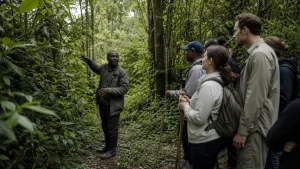
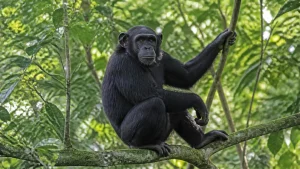
Gorilla trekking in Uganda’s Bwindi Impenetrable Forest or Rwanda’s Volcanoes National Park demands proper footwear. The terrain is steep, densely vegetated, frequently muddy, and relentlessly beautiful. Waterproof hiking boots with ankle support are strongly recommended — not suggested, not optional for most trekkers. You may be walking for two to six hours through equatorial forest. Waterproofing matters enormously. Gaiter sleeves that attach over boots to seal out mud are a practical addition.
Camp and Evening Footwear
- Flip-flops or slip-on sandals for use around camp, at the pool, and between activities
- One pair of light, comfortable shoes for lodge dinners or city stopovers
Total footwear for most safaris: one pair of trail shoes or light boots, one pair of sandals or flip-flops, and potentially one pair of waterproof hiking boots if gorilla trekking is on the itinerary. Three pairs. That is usually all you need.
Gear, Optics, and Electronics
This is where the safari experience gets amplified — or diminished — by what you bring. The difference between watching a leopard through the naked eye at 200 metres and watching it through quality binoculars is the difference between witnessing something and being inside it.
Binoculars
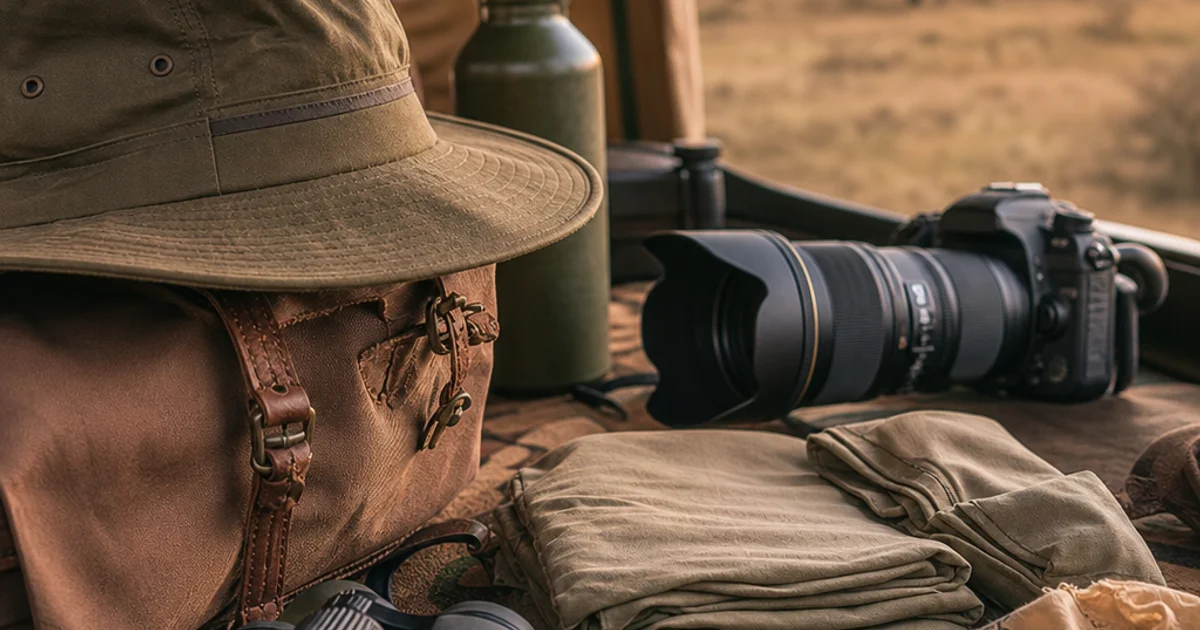
A quality pair of binoculars is arguably the most important piece of non-clothing equipment you will bring. An 8×42 or 10×42 configuration offers the ideal balance of magnification, field of view, and low-light performance for safari conditions. Dawn and dusk are peak wildlife hours — your binoculars need to perform in low light. Do not compromise here if you can avoid it.
Camera Equipment
- Your primary camera body — DSLR, mirrorless, or a high-quality compact with optical zoom
- A telephoto lens (200mm minimum; 400mm or more for serious wildlife photography)
- Extra batteries and a dual battery charger — power access at remote camps can be limited to certain hours
- Multiple memory cards — bring more than you think you need
- A bean bag or padded camera support for steadying shots on the vehicle’s window ledge
- A dust-proof camera bag or a dry bag for dusty game drive conditions
Electronics and Power
- Universal travel adapter (essential for multi-country itineraries)
- Portable power bank for charging devices during long drives
- Headlamp or compact torch — critical at remote camps where paths between tents and communal areas are not always lit
- E-reader loaded with books — long vehicle transfers and afternoon rest periods are perfect reading time
- Laptop optional — most travelers find they simply do not need it
A Note on Dust
Dust is one of the defining physical realities of the dry-season African safari. It gets into everything. Keep camera equipment in sealed bags during drives, use a lens cloth regularly, and store your phone in a zipped pocket rather than a cup holder. Dust is not a problem — it is part of the atmosphere — but protecting your electronics from it is a practical discipline worth developing.
If you are weighing up different safari formats and what gear might be most relevant, the guide on private versus group safari experiences is worth reading before you finalise your itinerary.
Health Essentials and Toiletries
Keep this category lean. Most lodges and camps provide basic toiletries, and the more you carry in liquid form, the heavier your bag becomes. The essentials are genuinely essential, however.
Sun and Skin Protection
- High-SPF sunscreen (SPF 50 minimum) — apply before every game drive; equatorial and high-altitude sun is relentless
- Lip balm with SPF
- Insect repellent — DEET-based or picaridin formulas are most effective in African bush environments
- After-sun lotion
First Aid and Personal Health
- Personal prescription medications — carry in hand luggage, never checked luggage
- A compact personal first-aid kit: blister plasters, antihistamine tablets, ibuprofen or paracetamol, antiseptic wipes, and rehydration sachets
- Motion sickness tablets if you are prone — some bush roads and small aircraft flights are genuinely turbulent
- Hand sanitiser — compact bottle for vehicle use
Toiletries
- Solid shampoo and conditioner bars (lighter than bottles, plastic-free)
- Compact biodegradable soap
- Microfibre travel towel (useful at camps where towels are not provided on activities)
- Wet wipes — essential for long drives far from facilities
- Any personal hygiene items not reliably available in remote destinations
Eyewear
- Quality wraparound sunglasses — polarised lenses reduce glare significantly on open water and in open grasslands
- Spare pair or contact lens supplies if relevant
Packing by Destination and Season
This is where the nuance matters most — and where a generic packing list starts to fall apart. The answer to “what should I pack?” is inseparable from where you are going and when.
East Africa — Kenya and Tanzania
The Serengeti and Masai Mara are warm year-round at lower elevations, but July and August mornings on an open game drive vehicle can be bracingly cold. A fleece and windproof outer layer are essential even in the dry season. The wet seasons — March to May and November — bring lush landscapes, fewer crowds, and dramatically different photographic conditions. Pack your waterproof jacket and quick-dry fabrics. If you are planning a Tanzania versus Kenya trip and are unsure which suits you better, the Tanzania vs Kenya safari guide breaks down the experience in detail.
Uganda and Rwanda — Gorilla Country
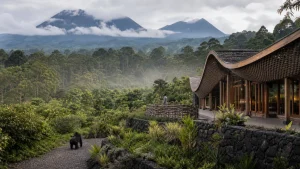
These are equatorial, high-altitude destinations. The humidity of Bwindi or Volcanoes National Park is something you feel the moment you step into the forest — dense, green, alive. Pack quick-dry everything. Waterproof hiking boots are essential. Long sleeves and trousers are required for trekking regardless of temperature. A pair of gaiters for muddy forest floors is genuinely useful. Pack light layers — you will warm up fast on the climb.
Southern Africa — Botswana, Zimbabwe, Zambia, Namibia
Southern Africa’s winter (June to August) is the peak dry season and prime game-viewing period — and it can be genuinely cold, particularly in Botswana’s Okavango Delta and on Zimbabwe’s highveld. Cold-weather layers, including a proper warm jacket, gloves, and a hat, are not overcautions — they are necessities before dawn. The summer months (November to February) bring heat, humidity in some areas, and dramatic afternoon thunderstorms. A lightweight rain jacket and moisture-wicking fabrics are essential then.
South Africa
South Africa’s game-viewing heartlands — Kruger, the Greater Kruger private reserves, and KwaZulu-Natal — span multiple climate zones. Summer (October to March) is hot and wet; winter (May to August) is dry and mild during the day but cold at night in the Lowveld. The Cape regions operate on a Mediterranean climate, essentially reversed from the north. Layer broadly, and check the specific region you are visiting.
For a full breakdown of when to visit each country and how it affects your experience, the African safari country-by-country timing guide is essential reading before you finalise your packing list.
The Master Safari Packing Checklist
| Category | Items |
|---|---|
| Bags | Soft-sided duffel bag, day pack (15–20L), foldable spare bag, packing cubes |
| Clothing | 3–4 long-sleeved shirts, 2–3 trousers/zip-off pants, 1–2 shorts, fleece, waterproof jacket, warm hat, gloves, scarf/gaiter, swimwear, sleepwear, 5–7 underwear, 4–6 socks |
| Footwear | Closed-toe trail shoes or light boots, sandals/flip-flops, waterproof hiking boots (gorilla trekking) |
| Optics | Binoculars (8×42 or 10×42), camera body, telephoto lens, extra batteries, memory cards, bean bag support |
| Electronics | Travel adapter, power bank, headlamp, e-reader |
| Health & Toiletries | Sunscreen SPF50+, insect repellent, lip balm, first-aid kit, personal medications, wet wipes, hand sanitiser, solid toiletry bars |
| Documents | Passport, visas, travel insurance details, operator contacts, vaccination certificate (yellow fever where required) |
| Extras | Polarised sunglasses, microfibre towel, rehydration sachets, small cash (USD widely accepted), fabric tote bags (no plastic carriers in East Africa) |
The Final Word Before You Zip Up Your Duffel
Packing well for a safari is not about having more — it is about having the right things, in a bag you can actually fly with, for conditions you have actually thought about. The traveler who packs a hard-shell suitcase for a Botswana fly-in safari learns that lesson at the airstrip. The traveler who brings only white shirts learns it somewhere dusty and permanent. These are avoidable lessons.
Pack for the cold mornings. Pack for the mud. Pack for the heat of midday in the Okavango when the only sound is the water and the birdsong. Pack for the moment the engine cuts and the silence arrives — and make sure you are comfortable enough to simply be in it.
If you still have questions about logistics, timing, or what to expect on the ground, the Safari Planning FAQ covers 45 of the most common pre-departure questions in one place. Everything you need to go is within reach. Now pack light, pack smart — and go.
Frequently Asked Questions
I’m planning an African safari; what luggage restrictions should I be aware of for internal flights?
Internal safari flights typically enforce strict weight limits of 15-20 kg per person, including hand luggage. You must use soft-sided duffel bags, as hard-shell suitcases and rigid frames are generally not permitted. These restrictions are due to the small, awkwardly shaped cargo holds of bush aircraft like Cessna Caravans.
Why can’t I bring my hard-shell suitcase on internal safari flights?
Hard-shell suitcases are typically not allowed on internal safari flights because the cargo holds of bush aircraft are narrow and awkwardly shaped. These rigid bags do not fit efficiently into the limited space, making soft-sided duffel bags a physical necessity for proper loading. Confirming specific dimensions with your operator is also advisable.
What colors should I pack for my safari wardrobe, and are there any to avoid?
For your safari wardrobe, neutral earthy tones are highly recommended and often non-negotiable. It’s crucial to avoid bright colors, as well as dark blue or black clothing, because they can attract insects like tsetse flies or startle wildlife. Sticking to muted colors helps you blend into the natural environment.
Why is layering my clothes so important for comfort during a safari?
Layering is essential for comfort on an African safari because the continent often experiences a full range of temperatures within a single 12-hour day. Mornings can be chilly, midday warm, and evenings cool again. Having adaptable layers allows you to easily adjust your clothing to stay comfortable throughout game drives and other activities.
What footwear is best for various safari activities like game drives or gorilla trekking?
The best footwear for a safari depends entirely on your planned activities. For active adventures like gorilla trekking in Uganda or Rwanda, proper waterproof hiking boots are a necessity. However, for typical game drives, comfortable closed-toe shoes are generally sufficient.
Do I need to pack a separate outfit for every day of my safari, or are laundry services available?
You do not need to pack a fresh outfit for every single day of your safari. Most safari lodges offer laundry services, which allows you to pack lighter and more efficiently. Utilizing these services provides the freedom to enjoy your trip without being burdened by excessive luggage.
Are there any restrictions on bringing plastic bags into East African safari countries?
Yes, countries like Kenya, Tanzania, Uganda, and Rwanda have introduced restrictions or outright bans on single-use plastic bags. It is important not to bring plastic carrier bags into these countries to comply with local environmental regulations. Instead, opt for fabric tote bags or reusable stuff sacks for your belongings.