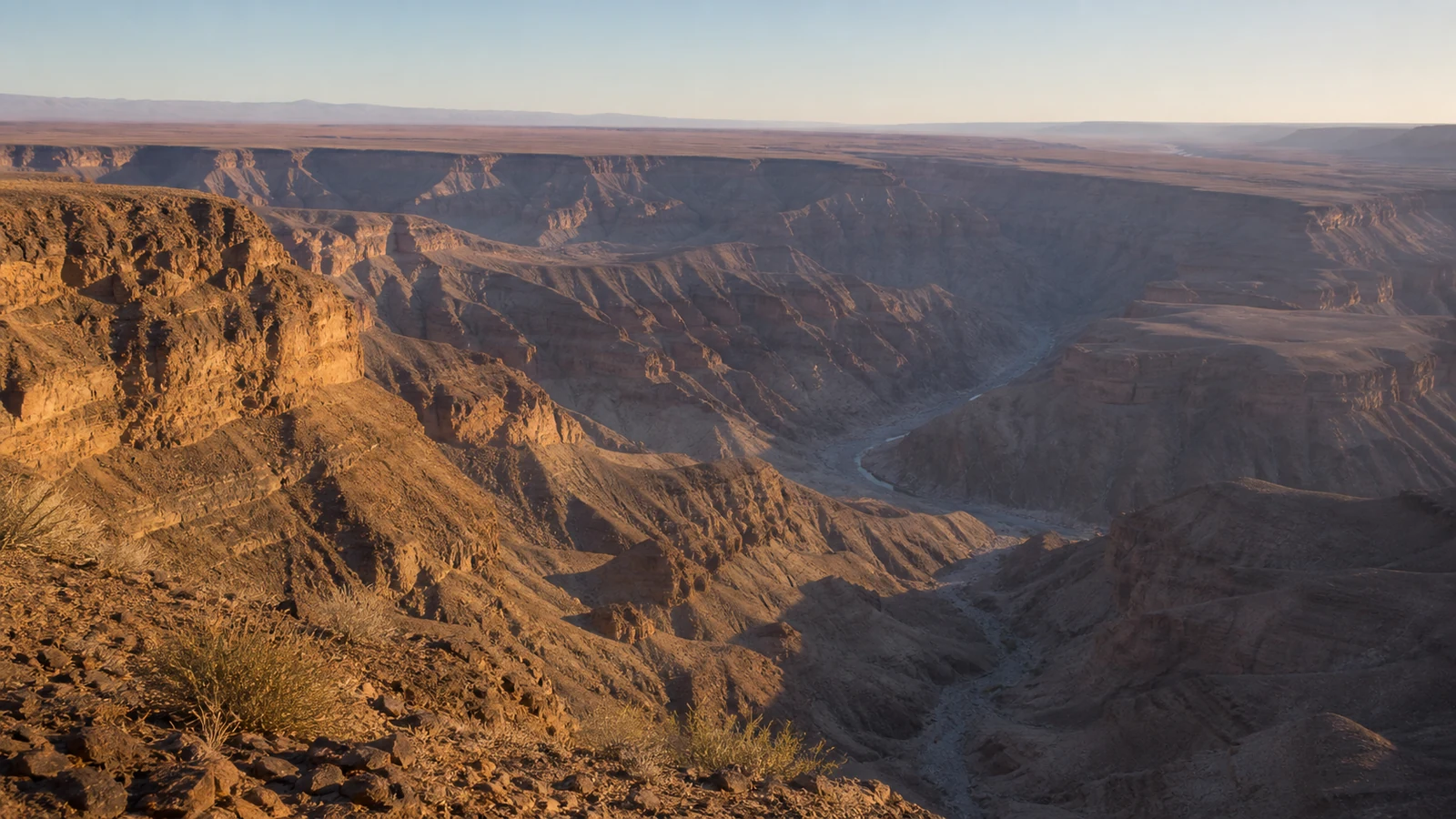
TL;DR – Fish River Canyon is the second largest canyon in the world and one of the most visually overwhelming landscapes in Africa. Most travelers drive past it in half a day. The ones who stay longer – who catch the sunset turn the rock purple, who hike the rim at dawn, who soak in the hot springs at Ai-Ais afterward – come back with a completely different story to tell.
- The Fish River Canyon viewpoints beyond Hobas offer perspectives on the geology and scale that the main overlook alone doesn’t deliver
- Sunset at the rim produces a color shift in the canyon walls that lasts twenty minutes and justifies the entire detour south
- The Fish River Canyon hike is one of southern Africa’s great wilderness walks – demanding, self-sufficient, and completely unlike any guided safari experience
- A southern Namibia itinerary anchored on the canyon, with Lüderitz and Kolmanskop added, covers ground that most Namibia travelers never reach
The Scale Problem
There’s a specific challenge that Fish River Canyon presents to every traveler who stands at its edge for the first time: the brain refuses to process what the eyes are seeing.
The canyon is 160 kilometers long, up to 27 kilometers wide, and drops 550 meters at its deepest point. Those numbers are accurate and completely useless for conveying what it actually feels like to stand at the main Fish River Canyon viewpoints and look out over a landscape carved by 500 million years of geological pressure and water.
The Grand Canyon in Arizona is larger. Everything else on earth is smaller. That’s the company Fish River Canyon keeps – and unlike the Grand Canyon, it receives a fraction of the visitors, has almost no crowds at the viewpoints, and sits inside a Namibian landscape that is itself extraordinary.
The scale problem resolves itself slowly. The longer you stay at the rim, the more the canyon gives back. An hour at the viewpoints produces something a ten-minute photo stop never reaches.
The Fish River Canyon Viewpoints: What to Know
The main viewpoint at Hobas sits above the canyon’s most dramatic bend – the point where the Fish River turns sharply and the full depth of the canyon becomes visible in a single sightline. This is the viewpoint that photographs, the one that appears in every Namibia travel piece, and it deserves every frame it gets.
But the Fish River Canyon viewpoints extend well beyond Hobas, and the difference between them is the difference between seeing the canyon and understanding it.
The northern viewpoints accessible from the Hobas rest camp give an overview of the canyon’s scale from above. The southern viewpoints, reached via a longer drive along the rim road, offer lower angles and closer perspectives on the canyon walls – the geology becomes legible here in a way it isn’t from the main overlook. The color of the rock shifts through the day: grey in the flat midday light, amber in the late afternoon, and – if the conditions are right around sunset – a deep purple that lasts for perhaps twenty minutes and looks like nothing that should exist in a landscape this austere.
We plan sunset at the rim on every Fish River Canyon itinerary we build. It’s non-negotiable.
The Fish River Canyon Hike: Who It’s For
The Fish River Canyon hike is one of the most demanding multi-day wilderness walks in southern Africa – and one of the most rewarding for guests who are ready for it.
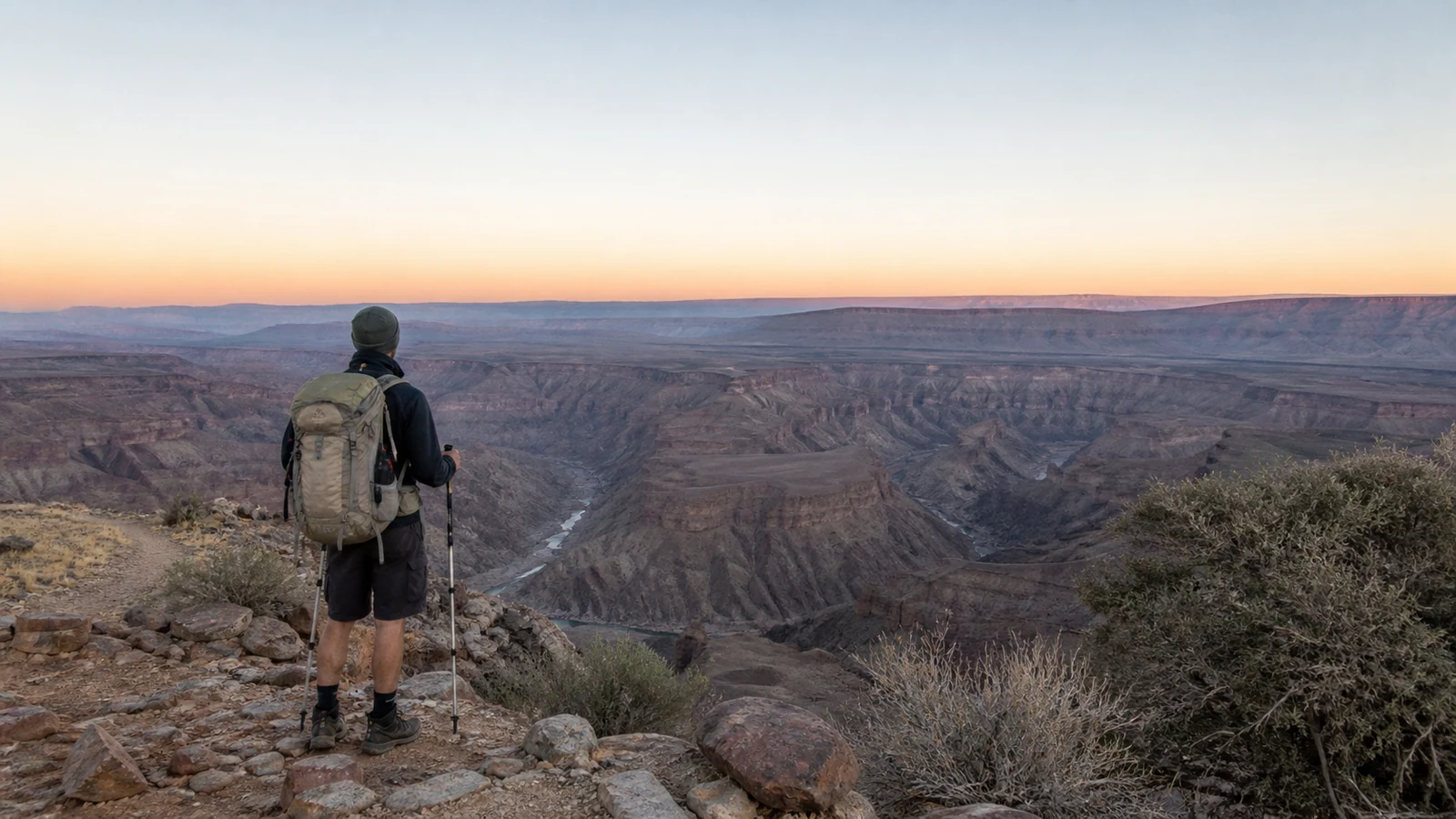
The route runs 85 kilometers along the canyon floor from Hikers’ Viewpoint in the north to Ai-Ais in the south, typically completed in four to five days. There are no facilities on the trail. No guides are provided. Hikers carry everything they need, navigate by the river and basic landmarks, and sleep on sand banks under skies that, at this remove from any light pollution, are genuinely disorienting in their density.
The trail is only open between May and September – the Namibian winter – because summer temperatures on the canyon floor reach levels that are genuinely dangerous. Even in winter, midday temperatures regularly exceed 35°C. The river provides water throughout the route, but the terrain is relentless: loose rock, deep sand, river crossings, and the particular fatigue of walking on a canyon floor where the walls on both sides remind you constantly of exactly how far down you are.
The Fish River Canyon hike requires a medical certificate of fitness, a minimum group of three people, and a permit booked through Namibia Wildlife Resorts well in advance. It fills up quickly for the May-September window.
For guests who want the canyon floor experience without the multi-day commitment, a guided day walk into the upper canyon from Hikers’ Viewpoint covers the most dramatic section and returns to the rim before dark.
Ai-Ais Hot Springs: The Canyon’s Finale
At the southern end of the canyon, where the Fish River emerges onto the flat plain before joining the Orange River at the Namibia-South Africa border, the Ai-Ais Hot Springs Resort sits in a setting that manages to be simultaneously utilitarian and extraordinary.
The springs themselves – sulfurous, mineral-rich, emerging at around 60°C and cooled to bathing temperature in the resort’s pools – have been used for centuries. The name means “scalding water” in Nama. After four days on the canyon floor carrying a full pack, the specific relief of lowering into a thermal pool with the canyon wall behind you is the kind of ending a trail deserves.
Ai-Ais Hot Springs work equally well as a standalone stop on a southern Namibia road trip – not everyone doing the canyon is hiking it. The resort offers comfortable accommodation, the pools are accessible to all guests, and the surrounding landscape, where the canyon opens into the wide plain of the Fish River valley, has its own stripped-back beauty that rewards a morning’s exploration before continuing south or turning back north.
Southern Namibia Itinerary: The Canyon in Context
Fish River Canyon sits in the far south of Namibia – a region that most itineraries either skip entirely or treat as a driving corridor between the Namibian highlands and the South African border. That’s a structural mistake in trip planning that we consistently correct.
A southern Namibia itinerary built around the canyon should include:
Lüderitz. The ghost town atmosphere of this former German colonial port on the Atlantic coast, an hour’s drive from the Sperrgebiet diamond mining area, is one of the most surreal urban environments in Africa. Art Nouveau architecture in a desert fishing town on the edge of the Namib. It shouldn’t work. It does completely.
Kolmanskop. The abandoned diamond mining town outside Lüderitz, where sand has reclaimed the interiors of German colonial houses to waist height and above. One of the most photographed sites in Namibia for good reason – and at dawn, before the tour groups arrive, one of the most quietly eerie places on the continent.
The Quiver Tree Forest. Near Keetmanshoop, a landscape of ancient aloe dichotoma trees that have been growing here for centuries. At sunset and sunrise, the light through the quiver trees is the kind of image that makes photographers stay an extra night.
Fish River Canyon as the anchor, with Lüderitz, Kolmanskop, and the Quiver Tree Forest as supporting destinations, creates a southern Namibia road trip that covers geological, historical, and botanical ground in a way the north-focused Namibia itinerary never reaches.
Only One Safaris on Where the Canyon Belongs in a Namibia Route
Fish River Canyon rewards patience in a way that most natural wonders don’t require. The scale is there immediately. The understanding of it – the geological time, the color changes through the day, the particular silence of standing at the rim with nothing between you and the canyon floor but 550 meters of ancient rock – arrives more slowly and stays considerably longer.
If Namibia is on your radar and your itinerary currently starts in Windhoek and heads straight to Etosha, we’d encourage a conversation about what the south contains before you finalize anything. We’ve built Fish River Canyon into dozens of Namibia itineraries and know exactly how to sequence it – rim timing, hiking permits, Ai-Ais logistics, and how to connect the south into a complete Namibia circuit that earns every kilometer of driving. Let’s talk through the map.
Frequently Asked Questions: Fish River Canyon: The Grand Canyon of Africa
When is the best time to visit Fish River Canyon viewpoints?
May through September for hiking access and the most comfortable temperatures. For rim viewing and photography, the winter months offer clear skies and the low-angle light that makes the canyon walls most dramatic. Sunrise and sunset are worth scheduling specific stops around – the canyon at midday in flat light is impressive; the canyon at golden hour is extraordinary.
Is the Fish River Canyon hike suitable for non-expert hikers?
It requires serious physical fitness and multi-day backpacking experience, but it’s not a technical climb. The challenge is endurance, heat management, and self-sufficiency over four to five consecutive days rather than any single technical difficulty. Guests who regularly do multi-day hiking and are comfortable with remote wilderness conditions are the right fit.
How do Ai-Ais Hot Springs fit into a canyon itinerary?
For hikers, Ai-Ais is the trail’s end point and the thermal pools are the natural reward. For non-hikers doing a southern Namibia road trip, Ai-Ais is a worthwhile overnight stop – the springs are accessible to all guests and the southern canyon landscape justifies a morning’s exploration before moving on.
Can Fish River Canyon be combined with a Namibia safari further north?
Yes, and we build it that way regularly. A southern Namibia road trip covering the canyon, Lüderitz, and Kolmanskop connects naturally to Sossusvlei and the Namib Desert further north, and from there to Etosha National Park for wildlife. The full Namibia circuit – south to north or north to south – is one of the strongest self-drive or guided road trip itineraries in Africa.
{
“@context”: “https://schema.org”,
“@type”: “FAQPage”,
“mainEntity”: [
{
“@type”: “Question”,
“name”: “When is the best time to visit Fish River Canyon viewpoints?”,
“acceptedAnswer”: {
“@type”: “Answer”,
“text”: “May through September for hiking access and the most comfortable temperatures. For rim viewing and photography, the winter months offer clear skies and the low-angle light that makes the canyon walls most dramatic. Sunrise and sunset are worth scheduling specific stops around – the canyon at midday in flat light is impressive; the canyon at golden hour is extraordinary.”
}
},
{
“@type”: “Question”,
“name”: “Is the Fish River Canyon hike suitable for non-expert hikers?”,
“acceptedAnswer”: {
“@type”: “Answer”,
“text”: “It requires serious physical fitness and multi-day backpacking experience, but it’s not a technical climb. The challenge is endurance, heat management, and self-sufficiency over four to five consecutive days rather than any single technical difficulty. Guests who regularly do multi-day hiking and are comfortable with remote wilderness conditions are the right fit.”
}
},
{
“@type”: “Question”,
“name”: “How do Ai-Ais Hot Springs fit into a canyon itinerary?”,
“acceptedAnswer”: {
“@type”: “Answer”,
“text”: “For hikers, Ai-Ais is the trail’s end point and the thermal pools are the natural reward. For non-hikers doing a southern Namibia road trip, Ai-Ais is a worthwhile overnight stop – the springs are accessible to all guests and the southern canyon landscape justifies a morning’s exploration before moving on.”
}
},
{
“@type”: “Question”,
“name”: “Can Fish River Canyon be combined with a Namibia safari further north?”,
“acceptedAnswer”: {
“@type”: “Answer”,
“text”: “Yes, and we build it that way regularly. A southern Namibia road trip covering the canyon, Lüderitz, and Kolmanskop connects naturally to Sossusvlei and the Namib Desert further north, and from there to Etosha National Park for wildlife. The full Namibia circuit – south to north or north to south – is one of the strongest self-drive or guided road trip itineraries in Africa.”
}
}
]
}