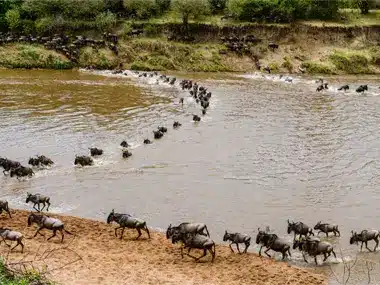
What Is the Mara River Crossing?
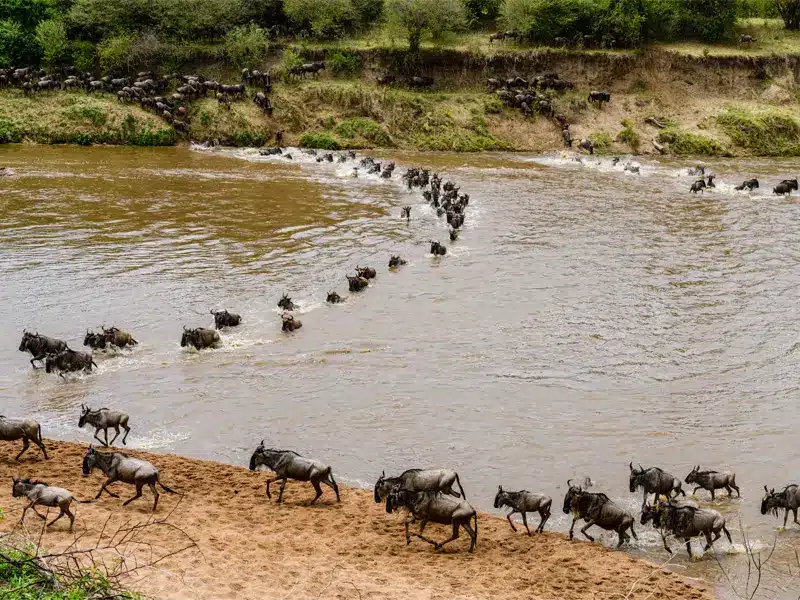
The Mara River crossing is the moment when herds of wildebeest – sometimes tens of thousands at a time – cross the Mara River during their annual migration through the Serengeti and into Kenya’s Masai Mara. It’s chaotic, violent, and extraordinary. Crocodiles wait in the water. The banks are steep and slippery. Animals pile in from behind pushing those at the front whether they’re ready or not.
It is not a single day event. That’s the first thing to understand.
The crossing happens repeatedly throughout the migration season – sometimes multiple times in a day, sometimes not at all for a week. The herds build at the river’s edge, test the water, retreat, build again, and eventually commit. When they go, they go all at once. The whole sequence can last 20 minutes or two hours. Then it’s over and the riverbank goes quiet again.
Migration Map July: How the Herds Move North
Understanding the migration map in July is the foundation of planning any crossing experience. The wildebeest don’t move randomly – they follow rainfall and fresh grass in a broad clockwise circuit through the Serengeti-Mara ecosystem.
Here’s the general movement pattern:
| Month | Location | What’s Happening |
|---|---|---|
| January – March | Southern Serengeti, Ndutu | Calving season – 500,000 calves born |
| April – May | Central Serengeti | Herds moving north, long rains slow progress |
| June | Western Corridor | Crossing the Grumeti River |
| July – August | Northern Serengeti, approaching Mara | Herds arrive in the north – crossings begin |
| September – October | Masai Mara (Kenya) | Peak crossing activity, herds in Kenya |
| November | Moving south again | Short rains trigger return migration |
| December | Southern Serengeti | Cycle completes |
The best time for river crossing in the Serengeti is July through October, with the peak concentration of crossings typically happening in August and September. July is when the herds first start arriving in the north and the earliest crossings begin – it’s exciting precisely because of the unpredictability.
One thing that catches people off guard: the herds don’t all move as one unit. Multiple columns of wildebeest are spread across the Serengeti at any given time, moving at different speeds and crossing the river at different points. This is why staying in the north for multiple nights dramatically increases your odds.
The Chaotic Scene at the Mara River
No description fully prepares you for what a crossing actually looks like up close.
The sound hits first. A low rumble that builds as thousands of hooves compact the earth on the far bank. Then the smell – dust, mud, the river. Your guide pulls the vehicle to the bank and cuts the engine.
The herd builds at the edge. Animals at the front look down at the water and back off. More animals push in from behind. The pressure builds. Then one wildebeest commits – leaps off the bank into the current – and within seconds the whole herd follows. The river fills with bodies. Crocodiles move in from downstream. Animals that make the crossing scramble up the near bank, legs slipping, and disappear into the bush within minutes.
The whole thing can be over in 20 minutes. You’ll spend the next hour trying to process what you just watched.
Kogatende Safari Camps: Staying in the Right Place
Location is everything for river crossing access, and Kogatende safari camps are the gold standard for northern Serengeti positioning. The Kogatende area sits directly on the Mara River in the far north of the Serengeti – the primary crossing zone – giving guests immediate access to the riverbanks without long drives.
The top camps in the area:
- Lamai Serengeti – perched on a rocky kopje above the Mara River with views directly over the crossing sites. The elevation gives you a perspective on the scale of the crossing that ground-level camps can’t match. One of the most visually dramatic camp positions in Tanzania.
- Nimali Mara – smaller and more intimate, with direct river access and an excellent guiding team that monitors herd movements daily.
- Sayari Camp – a classic northern Serengeti camp with a strong reputation for guiding and a location that covers multiple crossing points along the river.
The key advantage of all Kogatende camps over camps further south: when the herds are at the river, you’re already there. You’re not driving 90 minutes to reach the action – you’re having breakfast and watching wildebeest gather on the opposite bank.
Best Time for River Crossing Serengeti: What the Operators Won’t Always Tell You
The honest truth about the best time for river crossing in the Serengeti is that there’s no guaranteed window. What there is:
- July: Early crossings, less predictable, fewer tourists
- August: High activity, most reliable crossing frequency
- September: Still strong, herds spreading into Kenya
- October: Tail end of the season, herds starting south
Operators who promise you a crossing on a specific date are overselling. What you can control is staying long enough and being in the right place. Three nights minimum in the north. Five is better. Every day you’re there, your guide is tracking herd positions and getting you to the right crossing point at the right time.
The travelers who miss the crossing are almost always the ones who gave themselves one or two nights in the north on a packed itinerary. Don’t do that.
FAQ
When is the best time for river crossing in the Serengeti?
August and September see the highest frequency of Mara River crossings, but July through October is the full window. July is excellent for travelers who want the experience without peak-season crowds. The exact timing shifts year to year depending on rainfall patterns.
Where exactly do the Mara River crossings happen?
The main crossing points are in the northern Serengeti near Kogatende and along the border with Kenya’s Masai Mara. The most active sites shift depending on where the herds are concentrated – your guide will track this daily.
Can you predict when a crossing will happen?
No. Experienced guides can read herd behavior and identify when a crossing is building, but the wildebeest make their own decision. This is why multiple nights in the north is the only real strategy – you need to be there long enough for the odds to work in your favor.
Should I watch the crossing from the Tanzania or Kenya side?
Both offer spectacular experiences. The Tanzania side (northern Serengeti) tends to have fewer vehicles and more space at the riverbank. The Kenya side (Masai Mara) often has larger herds visible from camp. Many of our best itineraries cross the border and spend time on both sides.
The Mara River crossing is the kind of thing that changes how you think about scale – the scale of animal movement, of instinct, of how ancient this circuit really is. Getting there takes planning. But getting it right is entirely possible.
- July through October is the full crossing season – August and September peak
- Kogatende camps put you on the river, not an hour away from it
- Three nights minimum in the north – five is the smarter call
- No crossing is guaranteed, but positioning and patience get you there
If you want to build a Tanzania itinerary around the river crossing and actually give yourself a real shot at seeing it, that’s exactly the kind of planning we do. We know the northern Serengeti camps, we monitor the migration patterns each season, and we know how to structure your days so you’re in the right place at the right time.