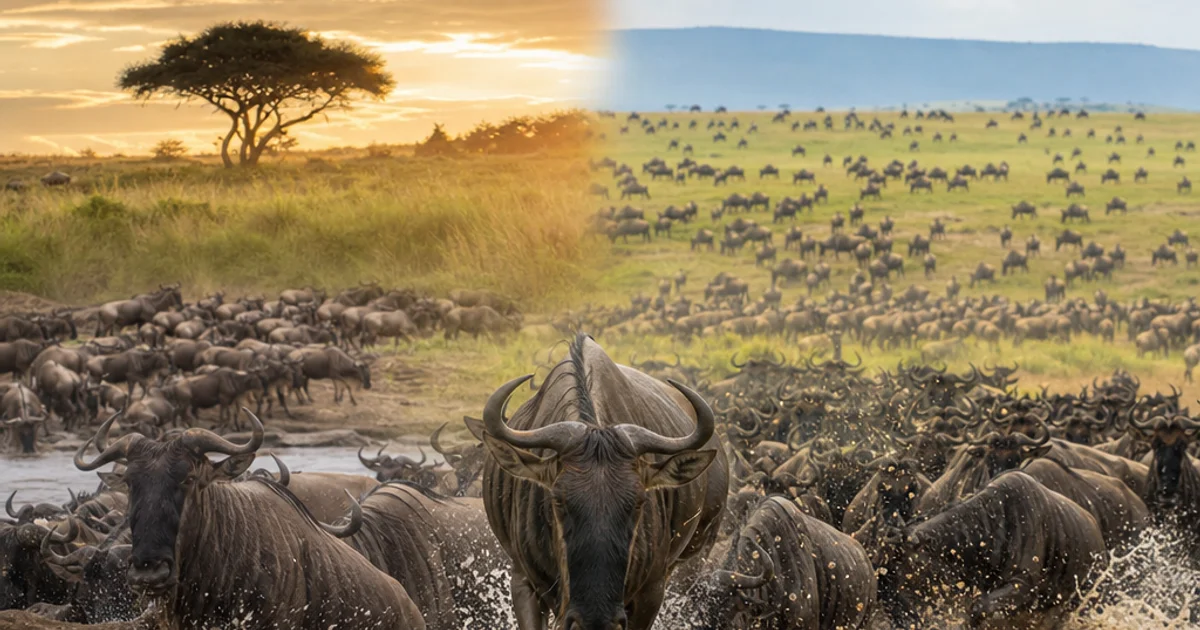
The ground trembles before you see them. A low, rolling thunder that builds from somewhere deep in the earth — and then they appear: a living river of wildebeest, hundreds of thousands strong, surging toward a crocodile-filled river with nothing but instinct driving them forward. This is the Great Migration, and it is the most extraordinary wildlife event on the planet. The question is: do you witness it from Tanzania’s Serengeti, or Kenya’s Maasai Mara?
The Serengeti vs Maasai Mara debate is one of the most common — and genuinely fascinating — decisions an African safari traveller will face. Both parks share the same herds, the same dramatic river crossings, the same cast of predators. Yet they offer experiences so distinct in feel, scale, and timing that choosing the wrong one for your trip could mean missing the chapter of this story that would have moved you most. This guide will help you choose wisely.
Key Takeaways
- The Great Migration is a year-round, circular movement of 1.5–2 million animals — not a single seasonal event. The Serengeti hosts the herds for the majority of the year; the Maasai Mara receives them for approximately 2–3 months (roughly July–October).
- If you travel between January and June, or November and December, a safari in Tanzania through the Serengeti is almost always the right choice.
- If you travel between July and October and want the iconic Mara River crossings with concentrated, high-intensity wildlife viewing, the Maasai Mara delivers a theatre-like experience unlike anywhere else on Earth.
- The Serengeti’s vast scale (14,750 sq km) creates a sense of profound wilderness solitude; the Maasai Mara’s more compact terrain (1,510 sq km) concentrates wildlife for frequent, close-up encounters.
- The ideal answer for many travellers is both — a combined Tanzania and Kenya safari that follows the migration across the border, experiencing two countries, two landscapes, and one epic story.
The Greatest Wildlife Show on Earth — And Two Front-Row Seats
The Great Migration is not an event you watch. It is something you feel. Every year, approximately 1.5 to 2 million wildebeest — accompanied by hundreds of thousands of zebra and gazelle — complete a continuous, clockwise circuit across the Serengeti-Mara ecosystem, following rainfall and fresh grass across one of Africa’s most iconic landscapes. There is no beginning and no end. The herds never stop moving.
At the heart of this ecosystem sit two of Africa’s most celebrated wilderness areas: Serengeti National Park in Tanzania and Maasai Mara National Reserve in Kenya. They are separated only by a political border, yet they feel like entirely different worlds. A safari in Tanzania through the Serengeti immerses you in an ancient, seemingly endless wilderness. A safari in Kenya through the Maasai Mara places you inside an intensely alive, dramatically concentrated wildlife arena.
Both parks are extraordinary. Both are worth visiting. But depending on when you travel and what kind of experience stirs something in you, one will be more right for you than the other. This guide breaks it down — by timing, by landscape, by experience type — so that when you finally stand at that riverbank with the ground shaking beneath your feet, you’ll know exactly how you ended up there.
For a broader comparison of both countries before diving into specific parks, our guide to Tanzania vs Kenya Safari: Which Country Should You Choose for Your First Safari? is an excellent starting point.
Understanding the Migration’s Year-Round Cycle
Here is the single most important thing to understand before booking: the Great Migration does not happen in one place at one time. It is a living, breathing, continuous circuit — and where the herds are depends entirely on when you visit. Most travellers are surprised to learn that the famous Mara River crossings represent just one chapter of a year-round saga that unfolds almost entirely within Tanzania.
January–March: Calving Season on the Southern Serengeti Plains
Location: Southern Serengeti / Ndutu Plains, Tanzania. This is, for many, the most emotionally overwhelming time to be in the Serengeti. The herds gather on the short-grass plains around Ndutu, and approximately 8,000 calves are born every single day during peak calving. The air is charged with new life — and with predators. Cheetah, lion, leopard, and hyena are present in extraordinary numbers, staging relentless hunts across open ground. The calving plains of Ndutu are as raw and tender as any moment in nature. An African safari at this time delivers something deeply primal: the full arc of life, death, and survival playing out across golden grass.
April–June: The Long March North Through the Western Corridor
Location: Central and Western Serengeti, Tanzania. As the long rains arrive, the herds begin their slow, deliberate march northward. They move through the Western Corridor — a narrow finger of the Serengeti that stretches toward Lake Victoria — and encounter the Grumeti River. Grumeti crossings are dramatic and deeply under-visited. The river’s resident giant crocodiles are famously large, and with far fewer safari vehicles present than during peak Mara season, the experience carries a sense of genuine, quiet wilderness that is increasingly rare.
July–October: The Mara River Crossings — Peak Season Across Both Parks
Location: Northern Serengeti, Tanzania / Maasai Mara, Kenya. The herds push into the northern Serengeti and across into the Maasai Mara, repeatedly crossing and recrossing the Mara River in scenes of almost unbearable intensity. This is the season that fills documentary footage and wildlife photography portfolios. The energy is electric. Both the northern Serengeti and the Maasai Mara offer access to these crossings during this window, meaning your choice between a safari in Tanzania or a safari in Kenya during this period comes down to landscape preference and experience style — which we’ll cover in the next section.
November–December: The Return Journey South
Location: Southern Serengeti, Tanzania. Following the short rains, the herds turn south again, streaming back through the Serengeti toward the calving grounds. This is one of the Serengeti’s most overlooked periods — the park is quieter, the light is softer, the grass is lush and green, and the sense of having the wilderness almost to yourself is deeply satisfying.
Summary answer to a common query: The best time to see the Great Migration in the Serengeti is year-round, with calving season (January–March) and the Mara River crossings (July–October) as the two peak events; the best time to see the Great Migration in the Maasai Mara is July through October, when the herds cross into Kenya.
For a full, country-by-country breakdown of when to visit, see our Best Time to Visit Each African Safari Country: Month-by-Month Wildlife and Weather Guide.
Serengeti vs Maasai Mara — Landscapes, Scale, and the Feel of Each Place
The Serengeti and Maasai Mara share a border and a migration, but they feel like entirely different worlds. The Serengeti is vast, ancient, and humbling; the Maasai Mara is concentrated, theatrical, and intensely alive. Understanding that difference is key to choosing the right park for your safari.
The Serengeti, Tanzania — Ancient, Boundless, Humbling
At 14,750 square kilometres, the Serengeti is genuinely enormous. It is one of the largest and oldest ecosystems on Earth, and it shows. The open golden grasslands seem to stretch without horizon. Mysterious granite kopjes — ancient rock formations that erupt from the flat plains — rise like temples. Riverine forests thread through the landscape, sheltering leopard and elephant. There are moments in the Serengeti when you will look in every direction and see nothing made by human hands. That feeling — of being genuinely, exhilaratingly small — is something you do not forget.
The Serengeti’s scale also means that mobile tented camps can follow the migration through the year, repositioning across different zones as the herds move. This creates an extraordinarily intimate, ever-changing safari experience — you are not waiting for the migration to come to you. You are living inside it.
The Maasai Mara, Kenya — Concentrated, Vivid, Theatrical
At 1,510 square kilometres, the Maasai Mara is far smaller — but what it lacks in scale it more than compensates for in intensity. The rolling, open terrain concentrates wildlife into a smaller viewing area, which means game drives in the Mara consistently deliver close, frequent, high-impact sightings. The sweeping vistas across the Mara Triangle are iconic for a reason: they are among the most beautiful views in African safari travel.
The private conservancies bordering the main reserve add another dimension entirely. Areas like the Olare Motorogi, Naboisho, and Mara North conservancies offer exclusive game viewing under special access rules — fewer vehicles per sighting, night drives, and walking safaris. If absolute exclusivity and intimacy matter to you, these conservancies represent some of the finest safari experiences Kenya has to offer.
On the Big Five front, both parks deliver exceptional sightings. However, rhino sightings are more reliably possible in the Maasai Mara’s Mara Triangle, where a small but growing black rhino population is actively protected.
| Feature | Serengeti (Tanzania) | Maasai Mara (Kenya) |
|---|---|---|
| Size | 14,750 sq km | 1,510 sq km (plus conservancies) |
| Landscape feel | Vast, ancient, solitary | Rolling, intimate, theatrical |
| Migration months | Year-round | July–October |
| Rhino sightings | Rare | More reliable (Mara Triangle) |
| Wildlife density | Spread across vast terrain | Concentrated, high frequency |
| Camp mobility | Mobile camps follow migration | Fixed lodges and private conservancies |
| Night drives | Limited inside national park | Available in private conservancies |
The River Crossings — Where the Drama Reaches Its Peak
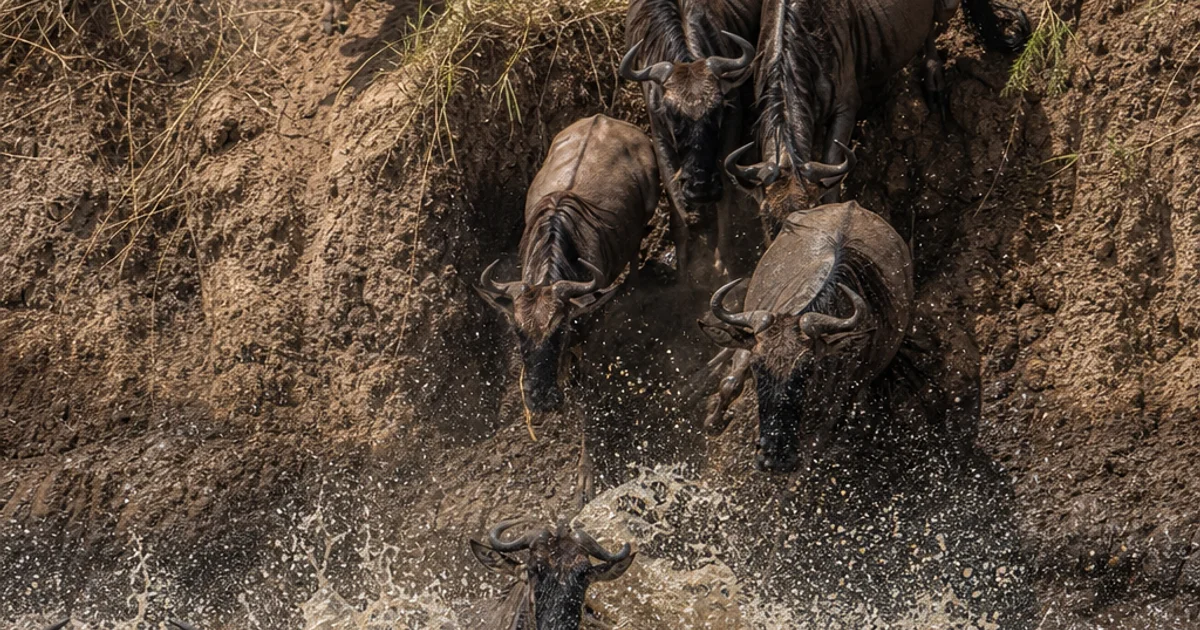
If there is a single image that defines the Great Migration in the global imagination, it is a Mara River crossing. Thousands of wildebeest massing on a bank, their calls rising into a roar, the water churning with crocodiles waiting below — and then, triggered by some invisible signal, the first animal leaps. And then the flood begins.
It is one of the most visceral, adrenaline-charged spectacles in nature. Nothing prepares you for the noise, the chaos, the sheer, desperate energy of it. Crocodiles surge. Animals stumble and recover. Some don’t make it. The survivors pour up the opposite bank and vanish into the grass, and within minutes, the river is still again.
Mara River Crossings in the Northern Serengeti vs the Maasai Mara
Here is something that surprises many travellers: the Mara River crossings happen on both sides of the Kenya-Tanzania border. During peak season (July–October), the herds cross back and forth multiple times, meaning both the northern Serengeti in Tanzania and the Maasai Mara in Kenya offer access to this spectacle.
The difference lies in the experience around the crossing:
- Northern Serengeti crossings tend to attract fewer vehicles, offering a more raw and unfiltered encounter. The landscape here is dramatic and less visited than the Mara, and the sense of witnessing something almost undiscovered is part of the appeal.
- Maasai Mara crossings can attract more vehicles during peak season, particularly at the most active crossing points. However, the Mara Triangle — managed separately by the Mara Conservancy — enforces stricter vehicle limits, preserving the quality of the experience significantly. The private conservancies surrounding the Mara further reduce crowds for guests staying within them.
The crossings themselves are unpredictable by nature. The herds may cross three times in a day or sit on the bank for hours, building tension, before retreating. Guides with years of experience reading the herd’s behaviour are invaluable here — another reason that how you structure your safari matters as much as where you go. To understand the differences between private and group safari structures, read our guide: Private vs Group Safari: Which Option Offers Better Value and Experience?
Which Park Suits Your Safari Style?
Beyond timing and landscape, your choice between the Serengeti and Maasai Mara may ultimately come down to the kind of traveller you are — and what you want to feel.
Choose the Serengeti if you want to:
- Witness the full arc of the migration — from calving to crossing to return
- Experience genuine wilderness solitude across vast, ancient terrain
- Travel in a mobile camp that repositions through the year, keeping you inside the action wherever the herds are
- Visit during the extraordinary but overlooked calving season (January–March), when predator activity is at its most intense
- Feel genuinely small in a landscape that has not changed in millennia
Choose the Maasai Mara if you want to:
- Maximise wildlife sightings per game drive in a concentrated, high-density area
- Experience the iconic Mara River crossings with access to the well-managed Mara Triangle
- Access private conservancies for exclusive game viewing, night drives, and walking safaris
- Combine a safari with Kenya’s other iconic experiences — the coast, Amboseli, or Samburu
- Increase your chances of seeing rhino in the wild
Choose both if you want to:
Follow the migration as it crosses the border — starting in Tanzania’s Serengeti during calving season and finishing in Kenya’s Maasai Mara during the river crossings. This is, without question, one of the greatest safari itineraries on Earth. Two countries, two landscapes, two chapters of the same magnificent story.
For guidance on how to structure your trip duration across both destinations, our guide to How Long Should Your African Safari Be? Ideal Trip Duration by Destination will help you plan realistically.
Practical Considerations: Getting There, Time Required, and Combining Both
Getting to the Serengeti
Most travellers fly into Kilimanjaro International Airport (JRO) or Julius Nyerere International Airport in Dar es Salaam, then connect via domestic flight to one of several Serengeti airstrips — including Seronera, Ndutu, Kogatende (northern Serengeti), and others. The domestic flight network in Tanzania is extensive and well-developed, making camp-to-camp movement smooth and efficient. A dedicated safari in Tanzania to the Serengeti typically requires a minimum of four nights to do the park meaningful justice; six to eight nights allows you to experience multiple zones.
Getting to the Maasai Mara
The gateway is Nairobi’s Jomo Kenyatta International Airport. A short domestic flight (approximately 45 minutes) reaches the Mara’s various airstrips, or a road transfer of around four to five hours is an option for those who want to take in the Kenyan countryside. A safari in Kenya to the Maasai Mara works well with three to five nights, though longer stays in the private conservancies reward those who linger.
Combining Both Parks
A combined Tanzania and Kenya safari is logistically straightforward — flying between the parks via Nairobi takes a matter of hours. Many operators design itineraries that link the two seamlessly. For first-time Africa travellers considering this combination, our in-depth comparison How to Choose Between Tanzania and Kenya for Your First African Safari covers the broader country-level decision in detail.
If you have broader planning questions — from visa requirements to what to bring — our comprehensive Safari Planning FAQ: 45 Questions Answered About Costs, Timing, Visas, Packing, and Safety has you covered.
So, Which Chapter Is Yours?
There is no wrong answer here. There is only the wrong timing.
If you can travel between January and March, go to the Serengeti — and go to Ndutu. Witness the calves stumbling to their feet within minutes of birth, and the cheetah watching from a hundred metres away. It will undo you in the best possible way.
If you travel between July and October and you want to stand at the Mara River while the earth itself seems to be in motion — go to the Maasai Mara. Stay in a private conservancy. Let a guide who has spent decades reading the herds take you to the crossing point at dawn. Wait. Be patient. And then watch the world change.
If your dates are flexible, or if this is a once-in-a-lifetime journey you have been planning for years — do both. Follow the story from beginning to middle. From the tender drama of the calving plains to the raw, primal fury of the river. From Tanzania’s endless golden wilderness to Kenya’s vivid, theatrical savanna. That, in full, is the Great Migration — and it is one of the few things on this planet that lives up entirely to its own legend.
The African safari you are imagining right now, the one that makes you feel something just thinking about it — it exists. You simply need to know which chapter to open first.
Frequently Asked Questions
What is the Great Migration, and where does it primarily occur?
The Great Migration is a continuous, year-round, clockwise circuit of 1.5–2 million wildebeest, accompanied by hundreds of thousands of zebra and gazelle, across the Serengeti-Mara ecosystem. It’s driven by rainfall and the search for fresh grass, with the herds never stopping their movement. The majority of this epic journey, including the crucial calving season, unfolds within Tanzania’s Serengeti National Park.
How do the Serengeti and Maasai Mara differ in scale and the wildlife viewing experience?
Tanzania’s Serengeti National Park, spanning 14,750 sq km, offers a sense of profound wilderness solitude due to its vast scale. In contrast, Kenya’s Maasai Mara National Reserve is more compact at 1,510 sq km, leading to more concentrated wildlife and frequent, close-up encounters. While both parks host the same herds, they provide distinct atmospheres, with the Mara often described as a theatre-like experience.
When should I visit the Serengeti versus the Maasai Mara to see the Great Migration?
If your travel dates fall between January and June, or during November and December, Tanzania’s Serengeti is almost always the right choice, as it hosts the herds for the majority of the year. For the iconic Mara River crossings and high-intensity, concentrated wildlife viewing, plan your trip to Kenya’s Maasai Mara between July and October, which is when the herds typically arrive.
Is the Great Migration a single, seasonal event, or does it happen throughout the year?
The Great Migration is a continuous, year-round cycle, not a single seasonal event. It is a living, breathing circuit where the herds are constantly moving in a clockwise pattern across the Serengeti-Mara ecosystem, always following rainfall and fresh grazing. The famous Mara River crossings represent just one chapter of this ongoing saga.
What are the “river crossings,” and where do they typically happen?
The river crossings are dramatic events where hundreds of thousands of wildebeest and zebra brave crocodile-filled rivers, most notably the Mara River, during their migration. These intense moments are a peak highlight, showcasing survival instincts. While crossings can occur at various points in the northern Serengeti, the most famous and concentrated ones happen in the Maasai Mara between July and October, as the herds make their way across the border.
Can I experience both the Serengeti and Maasai Mara on one safari trip?
Yes, combining both the Serengeti in Tanzania and the Maasai Mara in Kenya is often considered the ideal answer for many travelers. This approach allows you to follow the migration across the international border, experiencing two distinct countries, diverse landscapes, and different chapters of the same epic story. It offers a comprehensive perspective on the entire Serengeti-Mara ecosystem.
When is the calving season for the wildebeest, and where does it take place?
The calving season for the wildebeest typically occurs between January and March each year. During this time, the herds gather on the short-grass plains of the Southern Serengeti and Ndutu Plains in Tanzania. This period is incredibly dynamic, characterized by the birth of approximately 8,000 calves daily and intense predator activity.